The Rise and Fall of Measure E
This long-form essay details the promises and failings of the city’s voter-approved growth control ordinance, Measure E. With rapid city growth being a major issue among Thousand Oaks residents through the 1970s, 80s, and 90s, voters supported measures which put important changes to their city’s long-term development plan in their hands.
Or so they thought…
A deeper background of the crafting of Measure E and its 1996 campaign are part of the larger project: TUESDAY NIGHT FIGHTS - spanning the last half-century, detailing the birth and tumultuous rise of Thousand Oaks, California, which started from humble Western beginnings, served as a backdrop for Hollywood’s “Golden Age,” and became home to a global biotech giant and over 100,000 residents.
“Measure ‘E’ takes power from the politicians and puts it in the hands of the voters. The proponents of Measure ‘E’ trust the people. It’s that simple.”
“The City’s claim that Measure E will prevent overdevelopment is wrong. Measure E is riddled with loopholes.”
In 1996, Thousand Oaks voters were included as an official part of preserving the city’s General Plan, as ordinances were enacted requiring voter approval of important general plan changes before becoming effective. Sponsored by the two political protagonists of the time, Linda Parks authored the Parks Initiative, a precursor to the successful Ventura County SOAR open space protection measures, [3] while Andy Fox championed the city-sponsored Measure E.

Linda Parks, Thousand Oaks Mayor/Councilmember, 1996–2002, and Ventura County Supervisor, 2002-present
The Parks Initiative, qualifying for the ballot as a citizens’ initiative and approved in June 1996, focused on the parks and open space lands within the city. Under the initiative, lands categorized as ‘Parks, Golf Courses, Open Space’ “shall remain so designated… unless redesignated to another General Plan land use category by vote of the people”, [4] and “[w]henever the City Council adopts an amendment requiring approval by a vote of the people…, the City Council’s action shall have no effect until after such a vote is held and a majority of the voters vote in favor of it.” [5]
The language of the Parks Initiative provides clarity as to when the voters must be included for changes to the General Plan: if land is designated in a protected category and an amendment is proposed to designate that land otherwise, the amendment does not take effect until approved by the voters.
By defining the approvals that require voter concurrence plainly and specifically, the Parks Initiative established very effective protections. The clarity of language ensures that landowners and the public know the process for making any such changes. While not a prohibition, such a requirement lowers the likelihood of any such proposals being made, making for an effective measure for protecting open space.
Just one week after enacting Parks’ open space initiative, the three-member Council majority placed its own measure on the November 1996 ballot, which was approved by voters that fall. The ordinance now known as Measure E also proved effective as a tool in curbing development pressures within Thousand Oaks, but not for the reasons Measure E advocates claim.
In contrast with the Parks Initiative, the measure went through evolving tactics for implementation, based upon how interpretable the language is and the circumstances that gave councilmembers opportunities to modify their interpretations.
Measure E requires that “[a]ny amendment which cumulatively provides a net increase in the maximum number of residential dwelling units which could be permitted under the proposed land use designation” or “[a]ny amendment which cumulatively provides a net increase in the land designated ‘commercial’” requires voter approval. [6]
The challenge: what does “cumulatively provides a net increase” mean? Thirty years of asking that question led to widely varying answers.

Andy Fox, Thousand Oaks Mayor/Councilmember, 1994–2018
When Measure E was introduced to the Council, Mayor Andy Fox, the measure’s primary advocate, provided a way forward in a memo for such “minor changes in the General Plan…if these changes might mean that the residential and/or commercial uses might be increased. If the Council chose to do this, they would be required to do one of two things: (1) concurrently reduce densities and commercial space elsewhere in the City or (2) submit the proposed General Plan changes which would increase the City’s ultimate population or commercial areas to the voters.” [7]
To grant flexibility under Measure E without seeking voter ratification, the City Council could, for example, increase acreage designated as commercial in one part of the city, as long as an equal or greater amount of acreage were decreased elsewhere, thus resulting in no net increase of commercial acreage. If this were done, then according to Fox, the General Plan amendment would not need voter approval to become effective. [8]
Based on Fox’s 1996 memo, these offsetting shifts in residential density or commercial acreage were anticipated to occur “concurrently” — at the same time. In the succeeding years after Measure E’s passage, no issues arose regarding the measure, as only amendments decreasing residential or commercial lands were approved by the Council.
The first true test of Measure E came in 2001, when former Thousand Oaks Councilmember and Ventura County Supervisor Ed Jones sent a letter to the City representing Jerry Brodecky, owner of Thousand Oaks Toyota on Thousand Oaks Boulevard. Jones proposed that a portion of Brodecky’s property, about 1.2 acres, be redesignated from “medium density residential” to “commercial” to accommodate the dealership’s expansion. Noting that this could trigger Measure E, Jones proposed that “an alternative to a vote of the people be invoked in which it is demonstrated that an equivalent amount of land within the city has been rezoned by removing it from commercial since Measure E became law…” [9] Jones went on to recommend that this could be accomplished with land that “has been or is in the process of being removed from commercial and use that acreage to demonstrate that there will be no net increase…” [10]
Regarding the request, City Attorney Mark Sellers advised the Council that “[i]f land has been removed from the ‘commercial’ designated [sic] since 1996, and no equivalent offsetting increases have occurred, there is a net reduction which can be reallocated.” [11] A further memo from the City Attorney’s office advised that “[t]he Council controls how it will reallocate those past reductions in acreage of commercial uses.” [12] The Council initiated the General Plan amendment for Brodecky Toyota in 2003, [13] but also established an Ad Hoc General Plan Review Committee to evaluate the “applicability of Measure E to banking of commercial acreage and residential density.” [14] The Ad Hoc General Plan Review Committee comprised two members of the City Council - Mayor Pro Tem Bob Wilson and Councilmember Claudia Bill-de la Peña - and two members of the Planning Commission - Commissioner Tom Glancy and myself.
In the committee’s report back to the Council, one of the interpretations included processing “a simultaneous increase/decrease in commercial acreage or residential density” as a “single General Plan amendment, [which] could involve several properties” and that “[t]he scope of ‘net’ change could be clearly assessed by comparing/balancing the offsetting loss/gain in acreage or density among the properties.” [15]
The other interpretation involved creating a “bank” for any “reduced commercial acreage or the number of reduced residential units resulting from [a General Plan] amendment…approved since Measure E was adopted…” and that “[a] future request… to increase commercial acreage or residential units elsewhere within the City’s Planning Area could draw from the ‘bank,’ reallocating the reserved acreage or units to another site or sites… This option would permit greater flexibility… in that the acreage or units could be reallocated as needed, without going to the voters for approval.” [16]
Councilmember Bill-de la Peña and I supported the interpretation of evaluating each General Plan amendment on its own, consistent with how Measure E was originally proposed, assuming increases and decreases would occur “concurrently”; Mayor Pro Tem Wilson and Commissioner Glancy backed the banking option, which aligned with the preferred interpretation from the City Attorney’s office, based on previous memos.
Given the language of Measure E and the split among the committee, I recommended that we propose options for interpretation to the Council, as opposed to presenting a split recommendation; we all agreed that these were the options for interpreting the measure, even if we didn’t agree on which interpretation was preferred. The Council directed the City Attorney’s office to provide a deeper legal analysis, which was reported back to the Council the following year. [17]
City Attorney Mark Sellers stepped down from his post after 21 years of city service in 2004, [18] and Amy Albano began her tenure as his permanent replacement in 2005. [19] By mid-year, City Attorney Albano penned a formal eight-page legal opinion, guiding the City’s interpretation of Measure E. In effect, the concept of banking would be established, allowing the Council to use previous reductions in residential density or commercial acreage to balance future increases.

Thousand Oaks General Plan Land Use and Circulation Element map, circa 2017
In her analysis, Albano said that the Council should not consider reductions as being stored in a “bank” but rather a baseline to judge an amendment against. [20] She did argue, however, that some density reductions, even though approved after Measure E’s passage, shouldn’t be used to reduce the baseline, as these amendments were merely “ratifying current conditions” in the city and didn’t represent actual decisions by the Council to reduce density that could be reallocated later, since “to do so does not further the purpose of Measure E.” [21]
The Council accepted Albano’s analysis, excluding these amendments merely “ratifying current conditions,” and as a result, the Council’s 2005 policy established a baseline of reductions for future reallocation of 1 acre for commercial use and residential density allowing for 368 units. From this understanding, the Brodecky Toyota proposal was modified to reduce their commercial acreage request from 1.2 acres to 1 acre so that approval by the voters was not needed. [22]
This implementation approach became the governing interpretation of Measure E for the next decade, establishing a political environment where only requests for minor development increases were considered acceptable. Any sudden and sizable increases in residential development without voter approval would run counter to the stated intent of Measure E per the measure’s ballot argument that voters “should have the power to vote yes or no when significant changes to the General Plan are proposed.” [23]
Councils, Planning Commissions, and the public now had a clear understanding of how Measure E could be used to guide the city’s growth and development, which for decades targeted a city buildout number of around 50,000 residential units. [24][25][26][27][28][29][30][31][32][33][34][35]
In the years after this formal opinion, the City’s own reports made clear that they understood the 1996 Measure E baseline and operated accordingly.
For example, in 2005, owners of property along Thousand Oaks Boulevard formed a Business Improvement District and presented its draft Specific Plan to the City to guide future development for hundreds of acres along the Boulevard. [36]
When the City approved the Thousand Oaks Boulevard Specific Plan in 2011, the Council acknowledged the baseline: “In 2005, the City Council adopted a formal interpretation of Measure E that (1) established a baseline of residential density and a baseline of commercial acreage that existed in the Land Use Element of the General Plan at the time of its adoption in 1996.” [37]
The T.O. Boulevard Specific Plan approvals used all previous residential density and commercial acreage reductions, maxing out the General Plan relative to this baseline – the General Plan equaled the 1996 Measure E residential density baseline and was 0.88 acres under than the commercial acreage baseline. [38]
As a consequence, Boulevard property owners looking to expand development over what the new T.O. Boulevard Specific Plan authorized would need a General Plan amendment and gain approval from the voters to exceed the Measure E baseline. “If the General Plan amendment would cause City-wide [residential density or commercial acreage] to exceed the City-wide Measure E baseline, then the amendment must be approved by the electorate in accordance with the requirements of Measure E.” [39][40]
That changed a few years later, however, when new creative interpretations of Measure E were explored.

Mark Sellers, Thousand Oaks City Attorney, 1983–2004
In 2015, former City Attorney Sellers, who helped draft Measure E, was now a member of the T.O. Boulevard Business Improvement District (BID). Sellers believed the measure should be reinterpreted to allow more development without a citywide vote. [41]
Regarding Albano’s memo guiding the Council’s 2005 implementation of Measure E, Sellers said in an interview with the Thousand Oaks Acorn that “(Albano) made an interpretation that (she said) was ‘in the spirit of Measure E.’ I and a number of other people feel that was a wrong interpretation.” [42]
“What we have to do is get the city to take a new look at it. The BID would obviously love to have the new interpretation,” Sellers said. Under a new interpretation, Sellers said, “I believe the cap can be higher. In my 21 years as city attorney, I never saw a project that wasn’t underdeveloped (with) less homes than was contemplated by the zoning or the General Plan. Everything in this community has been underdeveloped. It’s a goal to use that flexibility.” [43]
In 2017, at the City Council’s May goal-setting session, Councilmember Fox called on City Staff to conduct a study to determine the Measure E baseline. [44] “I don’t think we’ve ever done an analysis of the entire city and the general plan at the time and the subsequent changes that we’ve made,” Fox said at the meeting. [45]
Mayor Bill-de la Peña, who had been involved with the implementation of Measure E for the past 15 years on the Council, reacted with surprise: “I’ve been operating under the assumption there was a certain number of units left in the Measure E bank, which was 600 something units,” she said. “Now I’m hearing that is not the real number.” [46]
Fox said he didn’t expect the study to drastically change the amount of housing the city will permit without turning to the ballot box. “We have grown to our city’s capacity,” he said. [47]
That, however, would not be the case.
Pursuing this newly conceived flexibility, the City followed through with an analysis to identify how more significant General Plan changes could be made without seeking voter approval. Belying decades of previous City approvals, reports, and documentation, the analysis stated that, from a Measure E perspective, “[t]he 1996 baseline… has never been determined” and that, as of 2017, the General Plan has “a baseline of about 81,000 units and 48,503 existing units in the Planning Area, leaving about 32,000 unbuilt units.” [48]
Based on this foundation, the Council initiated a General Plan amendment to tap into this newly discovered reservoir of residential density and avoid approval from voters. [49]

Thousand Oaks Acorn editorial, April 19, 2018
A Thousand Oaks Acorn editorial called out how they viewed the effort: “Truth be told, what city planners embarked on last summer was more search than study. A study typically has an unknown outcome, but here the outcome - a blueprint to grow the housing bank exponentially without triggering Measure E - was known first and the search for a rationale followed.” [50]
The Acorn urged the Council to “[r]eject the amendment and stick with what the majority of residents feel they were promised: the right to vote ahead of the demands of developers.” [51]
However, with this reinterpretation, the Council granted themselves license to establish a wholly new baseline, one that disregarded previous history and with far more headroom for increases without ever having to involve the voters; on a 4-1 vote, the Council approved the General Plan amendment to tap into just over 1,000 units of this unbuilt balance. [52][53]
The erosion of Measure E accelerated over the next few years, underscoring questions about whether the voters would ever be involved in the City’s General Plan decision-making as intended.
The next year, in 2019, the City initiated a comprehensive review of the city’s General Plan by forming the Thousand Oaks 2045 General Plan Advisory Committee (GPAC); I was selected as one of its 24 members, [54] along with former Mayor Andy Fox. Key to the committee’s work included providing inputs into a revised land use map which seemed to leave the city’s slow growth legacy behind.
Offering guidance to the GPAC and on how the public would be involved in the process, two Thousand Oaks mayors supported a public vote on the comprehensive General Plan update. Mayor Fox, champion of Measure E and ending his 24-year tenure on the Thousand Oaks City Council, included as part of his last State of the City address in 2018: [55]
“A comprehensive General Plan update that engages the entire community, culminating — I would recommend — in a citywide vote is essential to creating a vision for our next 50 years.”
Three years later, Mayor Bill-de la Peña reiterated support for her former colleague’s recommendation: [56]
“That’s why I joined former Mayor Andy Fox’s recommendation at his State of the City Address in 2018 that the new General Plan be put on the ballot box next November so that the residents can vote on it.”
Even with public encouragement from these city leaders for voter approval, city staff and external consultants crafted three alternative General Plan maps that “maximize [the] city’s capacity for housing” by “redistributing the 81,000 . . . in areas where the city can actually change and grow, potentially, over the next 10 to 20 years.” [57]
While still a member of the GPAC, I said at the time that “[a]ny of the three proposed alternatives would represent the most significant proposed expansion of development in the city’s history after the original 1970 General Plan.” [58]
In 2023, I was appointed to the Thousand Oaks Planning Commission for the fourth time and midway through the public review process for the comprehensive General Plan amendment itself. [59] When the plan came before the Planning Commission later in the year, the staff report stated that “[t]he General Plan 2045 land use map complies with the limitations of Measure E,” providing no mention of needing approval from the voters. [60]
And importantly, the updated General Plan came with yet another innovative interpretation: the new Mixed Use designation - even though it allows for residential and commercial uses at the same time - actually makes commercial acreage disappear under Measure E. [61][62]
By harvesting residential density from underdeveloped neighborhoods and maximizing their use within many more mixed use areas, in effect, the new General Plan is touted as (1) keeping residential density the same and (2) actually reducing commercial acreage throughout the city.
Therefore, under Measure E, no voter approval needed.
This again ran counter to how the City interpreted lands that allowed both residential and commercial uses in the past, specifically with respect to the Thousand Oaks Boulevard Specific Plan approvals. [63][64]
While Staff provided its rationale for this position during the City Council hearing, the response from Councilmember David Newman was that the explanation was “positively Orwellian” and the new tabulation of commercial acreage was an “accounting trick.” [65]
Since the language of Measure E was so malleable, these evolving interpretations, finalized through the 2023 citywide General Plan update, eventually removed the voters completely from the process they demanded to be part of.
In 1996, the proponents of Measure E told Thousand Oaks voters they would be part of the process for the next 30 years “because the voters should have the power to vote yes or no when significant changes to the General Plan are proposed.” [66]
They also claimed that “Measure ‘E’ takes power from the politicians and puts it in the hands of the voters. The proponents of Measure ‘E’ trust the people. It’s that simple.” [67]
The Council of the last decade proved that promise to be hollow and demonstrated how power can get clawed back by the politicians.
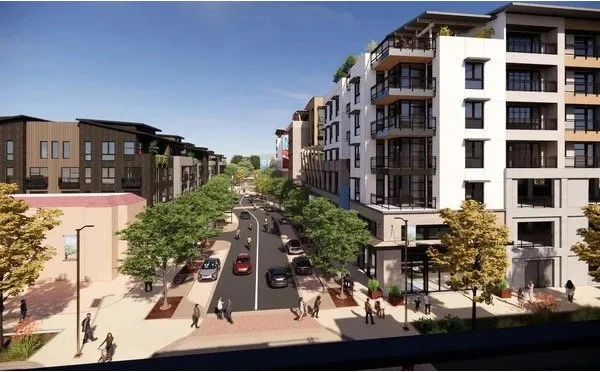
Artist rendering of the Thousand Oaks Downtown Project
However, there was one final failure for Measure E. Seemingly prescient of future Council actions, Councilmembers Elois Zeanah and Jaime Zukowski voted against placing Measure E on the ballot, [68][69] writing in their argument to voters against the measure: “The City’s claim that Measure E will prevent overdevelopment is wrong. Measure E is riddled with loopholes.” [70]
One of those loopholes: “Measure E exempts public property from voter approval.” [71]
In 2026, the City updated the Civic Arts Plaza Specific Plan with approval of the Downtown Thousand Oaks project - a major City-sponsored development that would bring a 142-room hotel and mixed-use development – some buildings standing 95 feet tall - into the center of the city next to City Hall and the Civic Arts Plaza. [72]
From a Measure E perspective, the plan added Mixed Use designations, adding more residential units over the 1996 Measure E baseline. Had the Downtown Project been sponsored by a private applicant, it would require voter approval under Measure E. [73] However, since this was a City-sponsored project on land “declared surplus as no longer needed for a public purpose,” [74] the project utilized the exemption from requiring voter approval, [75][76] one of the very “loopholes” that voters were warned about three decades earlier.

Measure E, Thousand Oaks City Council Resolution 96-126
Measure E sunsets in 2026, and with its full 30-year arc nearly complete, we can objectively evaluate its effectiveness and what lessons we can learn going forward.
The successes of voter approval measures are only as good as the text of the measures themselves.
If a measure’s language is clear and precise, such as with the Parks Initiative, the voters’ will is protected.
However, if the language is vague, as with Measure E, the measure could provide no protection at all, becoming dependent on the shifting interpretations and decisions of a narrow council majority.
In the end, the effectiveness of Measure E as a growth control instrument has merely paralleled the desire of the measure’s advocates to keep growth measured. If a Council majority chose to argue against a particularly intense development, opponents could point to Measure E as a politically convenient limitation. However, if the Council wanted to find ways to allow for growth, creative ways to navigate through Measure E’s language are explored, interpreting away the right to approve significant changes the voters thought they were guaranteeing by passing Measure E.
When restrictions are placed on the Council on what they can and cannot do, they can come in two forms: restrictions that are so clear that no one tests the measure, and restrictions that are so loose that they can always be interpreted away when convenient.
When it comes to including the voters in city decisions, the Parks Initiative qualifies as the former, and Measure E serves as the latter.
Notes and Sources
[1] Rebuttal to Argument Against Measure “E”, Sample Ballot and Voter Information Pamphlet, County of Ventura, City of Thousand Oaks, General Election, November 5, 1996.
[2] Argument Against Measure “E”, Sample Ballot and Voter Information Pamphlet, County of Ventura, City of Thousand Oaks, General Election, November 5, 1996.
[3] SOAR stands for Save Open-space and Agricultural Resources, https://soarvc.org/
[4] Ordinance No. 1285-NS, adopted June 18, 1996, and codified as Thousand Oaks Municipal Code, Section 9.2.204(b)
[5] Ordinance No. 1285-NS and Thousand Oaks Municipal Code, Section 9.2.204(d). Exceptions exist in subsection (c) if the redesignation is deemed necessary to avoid an unconstitutional taking of a private landowner’s property.
[6] Resolution 96-126, Thousand Oaks City Council June 25, 1996, and codified as Thousand Oaks Municipal Code, Sections 9.2.203(b)(2) and (3), as listed. However, research indicates that the ordinance approved by the Council codifying Measure E (1280-NS) contains errors. The current ordinance listed in the Municipal Code appears to be an older version of Measure E and not the version presented to the voters for approval.
[7] Memo to City Council from Andrew P. Fox, Mayor, “Subject: Growth Control,” April 22, 1996.
[8] Ibid.
[9] Memo to City Council from Mark G. Sellers, City Attorney, “Subject: Request of Mr. Brodecky on Thousand Oaks Toyota Expansion,” June 5, 2001. Attached letter from Ed Jones.
[10] Ibid.
[11] Memo to City Council from Mark G. Sellers, City Attorney, “Subject: Request of Mr. Brodecky on Thousand Oaks Toyota Expansion,” June 5, 2001.
[12] Memo to Chris Ronneberg, Associate Planner, from Nancy Kierstyn Schriener, Assistant City Attorney, “Subject: LU 2002–226/Brodecky — Applicability of Measure E,” August 20, 2003.
[13] Minutes of the Thousand Oaks City Council, September 2, 2003.
[14] Minutes of the Thousand Oaks City Council, September 16, 2003.
[15] Memo to City Council from Ad Hoc General Plan Review Committee, “Subject: 1. Applicability of Measure E Limitations on General Plan Amendments that increase Commercial Acreage or Residential Density. 2. Special Use Permits for Certain Commercial Uses in all Commercial Zones,” June 22, 2004.
[16] Ibid.
[17] Minutes of the Thousand Oaks City Council, June 22, 2004.
[18] Minutes of the Thousand Oaks City Council, January 27, 2004.
[19] Minutes of the Thousand Oaks City Council, December 14, 2004.
[20] Memo to City Council from Amy Albano, City Attorney, “Subject: Applicability of Measure E Limitations on General Plan Amendments That Increase Commercial Acreage or Residential Density,” June 14, 2005.
[21] Memo to City Council from Amy Albano, City Attorney, “Subject: Measure E Opinion,” June 6, 2005.
[22] Minutes of the Thousand Oaks City Council, July 26, 2005.
[23] Argument in Favor of Measure “E”, Sample Ballot and Voter Information Pamphlet, County of Ventura, City of Thousand Oaks, General Election, November 5, 1996.
[24] Memo from Department of Planning and Community Development to City Manager, “Subject: Draft Ballot Measure for November 1996 Election to Update Bedroom Tax,” May 7, 1996.
[25] Housing Mix Report, dated May 19, 1997 - Attachment to Memo from Linda Parks, Mayor Pro Tem, to City Council, “Subject: Establishing Conformance with the Policy of the General Plan to Have ‘An Appropriate Housing Mix of 80 Percent Single Family Units and 20 Percent Multiple Family Units,” January 14, 1998.
[26] Memo from Department of Community Development to Interim City Manager, “Subject: Housing Mix Policy (Referral 497),” April 28, 1998, Council received report May 5, 1998.
[27] Memo from Community Development Department, Planning Division to MaryJane V. Lazz, Interim City Manager, “Subject: Referral 500 – Consideration to Establish a General Plan Housing Element Policy Requiring 60% Single and 40% Two Story Dwelling in New Residential Subdivisions,” May 12, 1998.
[28] Memo from Community Development Department and City Attorney to Interim City Manager, “Subject: Options to Amend Measure " A" Residential Development Control System,” June 16, 1998.
[29] Affordable Housing Opportunities Assessment, City of Thousand Oaks, February 2003, Ch 1, p. 1, and Ch 2, p. 9.
[30] Memo from John C. Prescott, Community Development Director to Scott Mitnick, Interim City Manager, “Subject: Affordable Housing Study Session,” November 15, 2005, p 28.
[31] Memo from Community Development Department to Scott Mitnick, City Manager, “Subject: Status Report on City’s Housing Element Update and Draft 2005-2014 Regional Housing Needs Assessment (RHNA),” December 5, 2006.
[32] Impact Analysis for the Proposed Land Use/”Right to Vote on Traffic Congestion Initiative”, February 1, 2008, p. 30, received by Council February 5, 2008.
[33] Ibid., p. A-7.
[34] Thousand Oaks Boulevard Specific Plan, Final Environmental Impact Report, EIR No. 327, City of Thousand Oaks, September 2011, p 4.0-3.
[35] Memo from John C. Prescott, “Thousand Oaks Boulevard Specific Plan,” October 25, 2011.
[36] Resolution 2011-065, Thousand Oaks City Council, October 25, 2011.
[37] Memo from John C. Prescott, Community Development Director to Scott Mitnick, City Manager, “Thousand Oaks Boulevard Specific Plan — EIR No. 327 / SP 2009- 70129 / LU 2009- 70130 (Thousand Oaks Redevelopment Agency/City of Thousand Oaks),” October 25, 2011, p. 4.
[38] Resolution 2011-065, Thousand Oaks City Council, October 25, 2011.
[39] Ibid., Section 2 titled “Residential Density.”
[40] Ibid., Section 3 titled “Commercial Acreage.”
[41] Anna Bitong, “Measure E: under the microscope,” Thousand Oaks Acorn, February 5, 2015.
[42] Ibid.
[43] Ibid.
[44] Becca Whitnall, “Veteran council member calls for accurate housing count,” Thousand Oaks Acorn, June 1, 2017.
[45] Ibid.
[46] Ibid.
[47] Ibid.
[48] Memo to Andrew P. Powers, City Manager, from Mark A. Towne, Community Development Director, “Subject: Measure E Residential Baseline,” October 24, 2017.
[49] Minutes of the Thousand Oaks City Council, January 6, 2018
[50] “Give residents the vote they voted for,” Thousand Oaks Acorn, April 19, 2018.
[51] Ibid.
[52] Minutes of the Thousand Oaks City Council, April 24, 2018.
[53] Resolution 2018-017, Thousand Oaks City Council, April 24, 2018.
[54] Becca Whitnall, “General plan steering committee gets down to business,” Thousand Oaks Acorn, September 12, 2019, https://www.toacorn.com/articles/general-plan-steering-committee-gets-down-to-business/
[55] Andy Fox, State of the City Address, City of Thousand Oaks, https://www.youtube.com/watch?v=lQAbSICS5V4 (21:34), December 11, 2018.
[56] Claudia Bill-de la Peña, State of the City Address, City of Thousand Oaks, https://www.youtube.com/watch?v=vjlBXIozoMk (9:44), December 7, 2021.
[57] Kyle Jorrey, “Maps maximize city’s capacity for housing,” Thousand Oaks Acorn, February 18, 2021.
[58] Mic Farris, “The Thousand Oaks 2045 General Plan Update: Things You Need To Know,” February 17, 2021, https://www.micfarris.com/articles/the-thousand-oaks-2045-general-plan-update
[59] Minutes of the Thousand Oaks City Council, January 24, 2023.
[60] Memo to Planning Commission from Kelvin Parker, Community Development Director, “Subject: General Plan Amendment (GPA) 2019-70760-GPA; Environmental Impact Report (EIR) 2022-70558-EIR; Housing Element Update (HSG) 2018-70723-HSG,” November 13, 2023.
[61] “Planning Commission Meeting - November 13, 2023,” CTO Meetings, YouTube, November 13, 2023, https://www.youtube.com/watch?v=xwlJaoa8sA4 (1:15:36)
[62] “Thousand Oaks City Council Meeting - December 5, 2023,” CTO Meetings, YouTube, December 5, 2023, https://www.youtube.com/watch?v=rLxoxcu_6yc (3:15:24)
[63] Resolution 2011-065, Thousand Oaks City Council, October 25, 2011.
[64] Resolution 2014-021, Thousand Oaks City Council, May 13, 2014.
[65] “Thousand Oaks City Council Meeting - December 5, 2023,” CTO Meetings, YouTube, December 5, 2023, https://www.youtube.com/watch?v=rLxoxcu_6yc (3:18:03)
[66] Argument in Favor of Measure “E”, Sample Ballot and Voter Information Pamphlet, County of Ventura, City of Thousand Oaks, General Election, November 5, 1996.
[67] Rebuttal to Argument Against Measure “E”, Sample Ballot and Voter Information Pamphlet, County of Ventura, City of Thousand Oaks, General Election, November 5, 1996.
[68] Resolution 96-126, Thousand Oaks City Council, June 25, 1996.
[69] Minutes of the Thousand Oaks City Council, June 25, 1996.
[70] Argument Against Measure “E”, Sample Ballot and Voter Information Pamphlet, County of Ventura, City of Thousand Oaks, General Election, November 5, 1996.
[71] Ibid.
[72] Minutes of the Thousand Oaks City Council, June 23, 2026.
[73] “Planning Commission Meeting - May 18, 2026,” CTO Meetings, YouTube, May 18, 2026, https://www.youtube.com/watch?v=cbmW1zYXaoE
[74] Resolution 96-126, Thousand Oaks City Council, June 25, 1996.
[75] Memo to Planning Commission, from Kelvin Parker, Community Development Director, “Subject: Downtown Thousand Oaks Project,” May 18, 2026, City of Thousand Oaks, p. 15.
[76] Memo to Andrew P. Powers, City Manager, from Kelvin Parker, Community Development Director, “Downtown Thousand Oaks Project (CI 5540) located at 2100 E Thousand Oaks Boulevard, and some or all portions of 1868, 1934, 1938, and 1948 E Thousand Oaks Boulevard,” June 23, 2026, City of Thousand Oaks, p. 17.