AI Accountability
Who is actually accountable for these decisions?
If you’d like these posts delivered directly to you, subscribe to the Decisions newsletter now!

Is there enough accountability for the decisions made by artificial intelligence (AI) company executives?
We could ask this question of any corporate leader or public official – decisions that have significant effects on many people, but there seem to be little responsibility taken or accountability for their decisions at the moment.
Gary Marcus, professor emeritus of psychology and neural science at New York University, is known for his research on the intersection of cognitive psychology, neuroscience, and artificial intelligence. He’s been a critic of the development of AI for some time – in one thread on the technologicial pursuits (neurosymbolic vs large language model approaches), but most prominently, on the reckless deployment of the frontier AI models developed by companies like OpenAI and Anthropic. [1]
[By the way, I just finished the book Empire of AI by Karen Hao [2] – Hao’s reporting goes deeper into the history of OpenAI and mentions that Marcus testified at the same U.S. Senate hearing on AI as OpenAI’s Sam Altman – a fascinating read…]
Marcus recently advised that we “must recall open-ended AI agents with internet access from the market, now” [3] – I’ll explain why in a second…
There are concerns and fears about AI, which comprise a wide ranging set of local and global issues; this succinct list comes from IBM Think: [4]
Bias - such as applicant tracking systems discriminating against gender
Cybersecurity threats - cloning voices, generating fake identities and convincing phishing emails
Data privacy issues – wholesale scraping and collecting of information from websites to train their models
Environmental harms – incredible amount of electricity and water needed to run massive data centers with significant carbon footprints
Existential risks – experts in the field have been “urging measures to mitigate the risk of extinction from AI, equating it to risks posed by nuclear war and pandemics.”
Intellectual property infringement – AI can easily generate images, video, music, and content that mimic an artist’s form
Job losses – executives are voicing hope that AI can eliminate the need for jobs of many workers, especially information workers, saving money on salaries.
Lack of accountability – “Who is responsible when an AI system goes wrong? Who is held liable in the aftermath of an AI tool’s damaging decisions?”
Lack of explainability and transparency – AI models are often perceived as black boxes, where even the AI researchers who work closely with the technology don’t understand how the models make decisions.
Misinformation and manipulation – the mimicry of content is now getting good enough that bad actors rely on it heavily to influence people’s decisions and action.
With all of this, the solution from the Trump administration: we’re going to trust these technology companies themselves to “self-police.” This from AP News reporting: [5]
President Donald Trump [in late September] said that he and a large group of leaders of artificial intelligence companies had signed a voluntary accord that will include internal and external reviews during a meeting at the White House aimed at addressing Americans’ fears about the technology.
“I think I’m seeing tremendous self-policing. And they understand that they have to self-police,” Trump told reporters during an impromptu press conference outside the West Wing.
Trump and House Speaker Mike Johnson met with leading executives from top tech firms that are spending hundreds of billions of dollars to build out AI infrastructure, including data centers in communities across the country, which have sparked grassroots, bipartisan opposition.
The accord was signed by Trump, Anthropic CEO Dario Amodei, Google CEO Sundar Pichai, Meta CEO Mark Zuckerberg, OpenAI President Greg Brockman, Nvidia CEO Jensen Huang, and Elon Musk, founder of xAI, which is now part of SpaceX.
Checks and balances work only when differing sets of ambition works to prevent the excesses of the others – those concerned about the risks should be at the table to check against those causing them. Solely trusting the tech executives likely isn’t going to serve the public interest effectively enough.
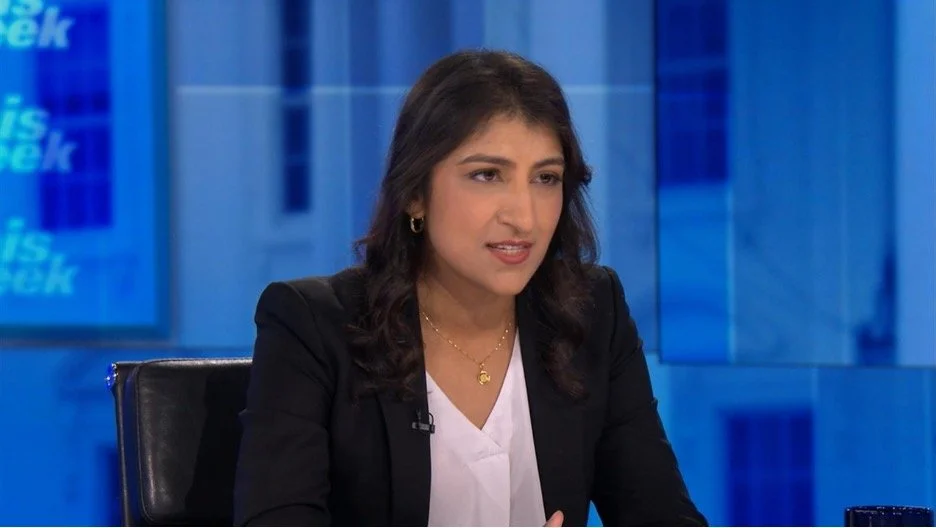
Former Chair of the Federal Trade Commission Lina Khan appearing on ABC's "This Week." (From ABC News)
Former Chair of the Federal Trade Commission Lina Khan voiced this concern recently, dismissing the “constitution” laid out by these tech executives. This from ABC News reporting: [6]
“We need to remember what happened a decade ago, where you had big tech companies, social media companies, similarly suggest that existing laws and regulations no longer apply to their new technologies, and that they were going to try instead to self-police,” Khan said [shortly after the tech executive White House meeting] on “This Week with George Stephanopoulos.”
“We've seen just innumerable harms come from the unchecked domination of these big tech companies, and so now as we face new horizons with these advanced AI systems, it would be an enormous mistake to repeat that playbook," Khan continued.
Lots of raised concerns, but how is it going so far? Well… this from New York Times reporting about Anthropic, the maker of Claude: [7]
Artificial intelligence agents created by Anthropic, acting on their own, tried to gain access to a range of government websites, filled out visa applications on the State Department’s website and sent a fake homicide tip to Philadelphia’s Police Department.
Anthropic detailed the activity of its A.I. agents in a blog post on Friday, without naming the targeted websites. But two sources with knowledge of the incidents said Anthropic’s A.I. agents had submitted 20 visa applications through a form available on the State Department’s website. All the applications were incomplete and were not processed, they said.
White House officials said they were briefed on the agents’ actions on Friday, and demanded that A.I. companies immediately report rogue A.I. activity. It was the most aggressive statement so far on A.I. regulation by the Trump administration, which has sidestepped calls for tighter controls on the increasingly powerful technology.
And Anthropic’s response to this activity from their software agents – a blog post about the “unintended model actions” of their product. [8]
This hits on the 8th of the AI issues I listed above – lack of accountability. “Who is responsible when an AI system goes wrong? Who is held liable in the aftermath of an AI tool’s damaging decisions?”
These products – before there was this thought of “AI” as independent decision makers - might be treated as defective if they resulted in these events, some of which are quite serious. But some of the CEOs just think we’ll have to put up with the consequences to realize their grand visions.
OpenAI’s CEO Sam Altman recently stated that “we believe that the world should accept some bad things happening for the benefits of this technology and people having the agency.” [9]
Just to highlight the differences in accountability: If a human being a false homicide tip to the Philadelphia Police Department, what would the consequences be? Here’s what one of Philadelphia’s law firms, van der Veen, Hartshorn & Levin, has to say about it: [10]
Penalties for Providing False Reports
Lying to law enforcement may seem like a very minor thing. However in the eyes of the law, it’s a fairly serious crime. The job of law enforcement is to get dangerous people off the streets, and protect everyone in their community. When they are lied to, particularly when it is to falsely incriminate someone else, it makes the job of law enforcement much more difficult. Those convicted of providing false information to law enforcement face harsh penalties.
In Pennsylvania, those penalties vary depending on the circumstances of the crime. If a person knowingly provides false information to law enforcement, it is considered a misdemeanor in the third degree. For those convicted, this crime is punishable by up to one year in prison and a maximum fine of $2,500.
The penalties become more serious when a person knowingly provides false information with the intent to incriminate another person. This is considered a misdemeanor in the second degree. The penalties if convicted are up to two years in jail and a maximum fine of $5,000.
In the event that a person provides false information to law enforcement during a declared state of emergency, and the false information takes law enforcement away from helping with that emergency, the crime is upgraded and the penalties increase.
If a human submitted false information about a homicide to law enforcement, the person could face a fine and be put in prison. Or, even if a person deployed an automated script to submit this information, that person who pressed the “go” button would likely be held accountable.
But if AI agents do this “acting on their own” as the New York Times put it, there is no accountability to any person. People create the products, but the same people will argue that their creations just did this on their own. And, as Altman put it, we “should accept some bad things happening.” [11]
Decision making isn’t perfect, and we learn from mistakes that we made or from decisions that may not have worked out as we’d hoped. But it seems like rationalization and blame-shifting - two human inventions of after-the-fact decision making - are being applied to AI technology development and deployment.
The issues we are facing are not technology ones – somehow building better products will not mitigate these risks.
Instead, our systems of accountability for decision makers are where the real work lies – in AI and elsewhere. Address the accountability issues and we take a solid step toward actually realizing the benefits that this amazing AI technology holds.
Our checks and balances need to be in place and strengthened – and we’re the ones that need to take up that mantle. Holding decision makers accountable, so that people know they will be held accountable for their decisions is the way we get better decisions in the end.
Notes and Sources
[1] “Gary Marcus,” Wikipedia, retrieved October 17, 2026, https://en.wikipedia.org/wiki/Gary_Marcus
[2] Karen Hao, Empire of AI: Dreams and Nightmares in Sam Altman's OpenAI, New York: Penguin Press, 2025
[3] Gary Marcus, “We must recall open-ended AI agents with internet access from the market, now,” Marcus on AI, Substack, October 9, 2026, https://garymarcus.substack.com/p/we-must-recall-open-ended-ai-agents
[4] Rina Diane Caballar, “10 AI dangers and risks and how to manage them,” IBM Think, retrieved October 17, 2026, https://www.ibm.com/think/insights/10-ai-dangers-and-risks-and-how-to-manage-them
[5] Christopher Rugaber, Will Weissert, and Meg Kinnard, “Trump says top tech firms have signed accord to ‘self-police’ AI development,” AP News, September 29, 2026, https://apnews.com/article/trump-ai-anthropic-musk-595796511f110fc006cca0d01329733e
[6] Isabel Danzis, “Former FTC Chair Khan dismisses 'constitution' signed by AI leaders to self-police,” ABC News, October 4, 2026, https://abcnews.com/Politics/former-ftc-chair-khan-dismisses-constitution-signed-ai/story?id=136984695
[7] Kate Conger, Mike Isaac, Julian E. Barnes and David E. Sanger, “Anthropic Agents Tried to Fill Out Visa Forms on State Dept. Website,” New York Times, October 9, 2026, https://www.nytimes.com/2026/10/09/technology/anthropic-rogue-ai-agents.html
[8] “Investigating unintended model actions in our evaluations and internal use,” Anthropic, blog post, October 9, 2026, https://www.anthropic.com/research/investigating-unintended-model-actions
[9] Christine Mui and Brendan Bordelon, “Sam Altman to Decoded: ‘The world should accept some bad things happening’ for the benefits of AI, Politico, October 4, 2026, https://www.politico.com/news/2026/10/04/sam-altman-decoded-interview-ai-01106217
[10] “Is It Illegal to Knowingly Give Police False Information?” van der Veen, Hartshorn & Levin, blog post, June 12, 2019, https://www.mtvlaw.com/blog/2019/june/is-it-illegal-to-knowingly-give-police-false-inf/
[11] Mui and Bordelon, “Sam Altman to Decoded,” Politico, October 4, 2026.
Decisions with Mic Farris
Seek Truth. Honor Differences.