Calvinball
A game with no rules and not great for public decision making.
If you’d like these posts delivered directly to you, subscribe to the Decisions newsletter now!
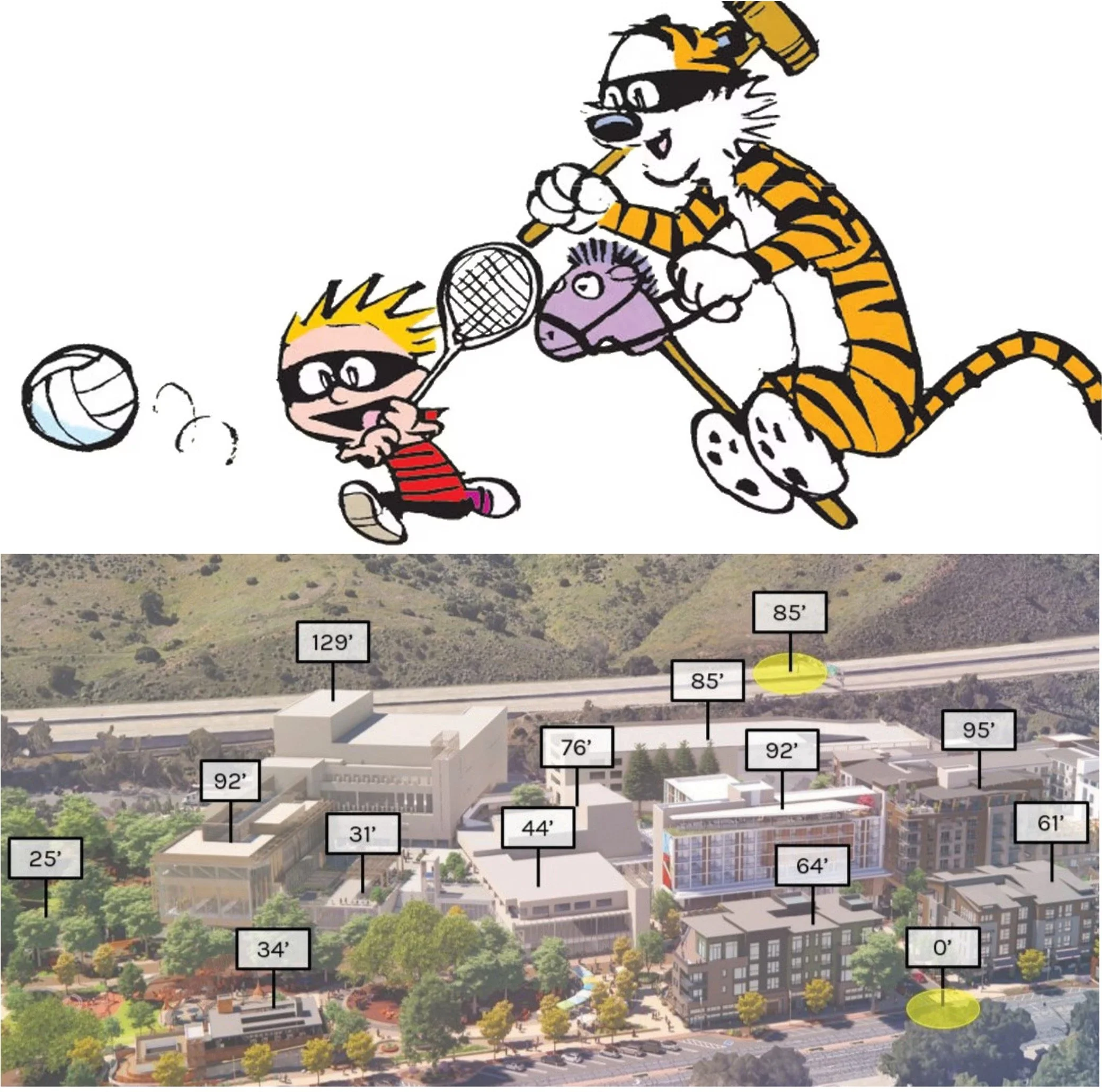
Top: Calvinball from Calvin and Hobbes
Bottom: Heights of existing and proposed buildings in the downtown area are illustrated, City of Thousand Oaks
Calvinball
You may not know the word "Calvinball," but you've seen the game played.
In Bill Watterson's Calvin and Hobbes, Calvinball is a game with one permanent rule: you can never play it the same way twice. [1] There are no fixed rules. The rules are invented in the moment, by whoever needs them most, to produce the outcome they want. It is, effectively, a game with no rules at all.
That can be funny in a comic strip, but when it describes how decisions get made in our institutions, it’s less amusing.
Two weeks ago, the Thousand Oaks Planning Commission voted 4-1 to recommend approval of the Downtown Thousand Oaks project - a major City-sponsored development that would bring a 142-room hotel and mixed-use development – some buildings standing 95 feet tall - into the center of our city. [2] I was the dissenting vote. Here's what I said at the hearing: [3]
As the role of the Planning Commission, our job is to evaluate the project relative to what the City Council's policies have put in place…
The thing that concerns me the most, I think, is we did go through an entire process of evaluating [pressures from Sacramento] of allowing [in our General Plan] for more multi-unit housing and dealing with increased density to allow heights to get higher than what we had normally been accustomed to wanting to see.
There were 35 foot maximums before. Mixed use land use designations are now 50 ft, and if there's a specific plan or higher overlay zone, it can go up to 75 ft.
And this project says we still want it to be more than that [to 95 ft]…
It's like we're not even following our own policies that we just went through a long citywide process to put in place.
This is the heart of it. The city spent considerable time and public engagement updating its General Plan - working through the pressures from Sacramento, grappling with density, establishing height limits that balanced growth with community character. That process took years and produced a set of policies.
And then a project arrived - sponsored by the City itself - that exceeded those policies, and the response was essentially: we'll make an exception.
That's Calvinball.
The same pattern is playing out at the national level. In August 2025, U.S. Supreme Court Justice Ketanji Brown Jackson used the term explicitly in a dissenting opinion, describing the Court's conservative majority as engaging in "Calvinball jurisprudence with a twist," [4][5] adapting rules in real time in a way that ensured the administration always wins. The reference called out what she perceived to be happening: the rules are shifting to produce the desired outcome, not to apply a consistent standard.
This is outcome-based decision making in plain sight. The decision is already made - the project gets built, the administration gets what it wants - and the rules are adjusted around it to provide the appearance of a principled process.
There's a judicial concept that exists precisely to prevent this: stare decisis - the principle that courts should honor precedent, because consistency of interpretation allows people to plan, to trust, and to rely on the system. The same principle applies to planning commissions, city councils, and regulatory bodies. When we establish policies through a rigorous public process and then carve out exceptions the moment a preferred project arrives, we haven't just bent the rules. We've communicated that the rules don't really bind anyone who matters.
But the deeper cost isn't just one project at 95 feet instead of 75; it’s the lessons that we all learn.
For future applicants, they learn that the rules are negotiable. For residents, they learn that the process you participated in was advisory at best. For the decision makers in the system, they learn that the outcome is what matters, and the rules are what you reach for when the outcome is already secured.
A decision environment that changes its rules to fit each desired outcome produces chaos over time. More errors. More uncertainty. Less trust. Not because any single exception becomes a crisis, but because the system itself - the reliable, predictable framework that allows good decisions to compound - has been quietly hollowed out.
In the end, we should aspire to play better games than Calvinball.
Notes and Sources
[1] “Calvinball,” Calvin and Hobbes Wiki, Fandom, retrieved May 30, 2026, https://calvinandhobbes.fandom.com/wiki/Calvinball
[2] Memo to Planning Commission, from Kelvin Parker, Community Development Director, “Subject: Downtown Thousand Oaks Project,” May 18, 2026, City of Thousand Oaks, https://toaks.primegov.com/viewer/preview?id=0&type=8&uid=2e740097-7217-4f93-a0d0-ce35065d8a9b
[3] “Planning Commission Meeting - May 18, 2026,” CTO Meetings, YouTube, May 18, 2026, https://www.youtube.com/watch?v=cbmW1zYXaoE
[4] “Calvinball jurisprudence,” Dictionary.com, retrieved May 30, 2026, https://www.dictionary.com/culture/politics/calvinball-jurisprudence
[5] National Institutes of Health v. American Public Health Association, 606 U. S. ____ (2025), Case No. 25A103, August 21, 2025, https://www.supremecourt.gov/opinions/24pdf/25a103_kh7p.pdf
Decisions with Mic Farris
Seek Truth. Honor Differences.