Cracks in American Democracy: Louisiana Edition
Three stories from the Bayou State remind us that the fight for free and fair elections is not over.
If you’d like these posts delivered directly to you, subscribe to the Decisions newsletter now!
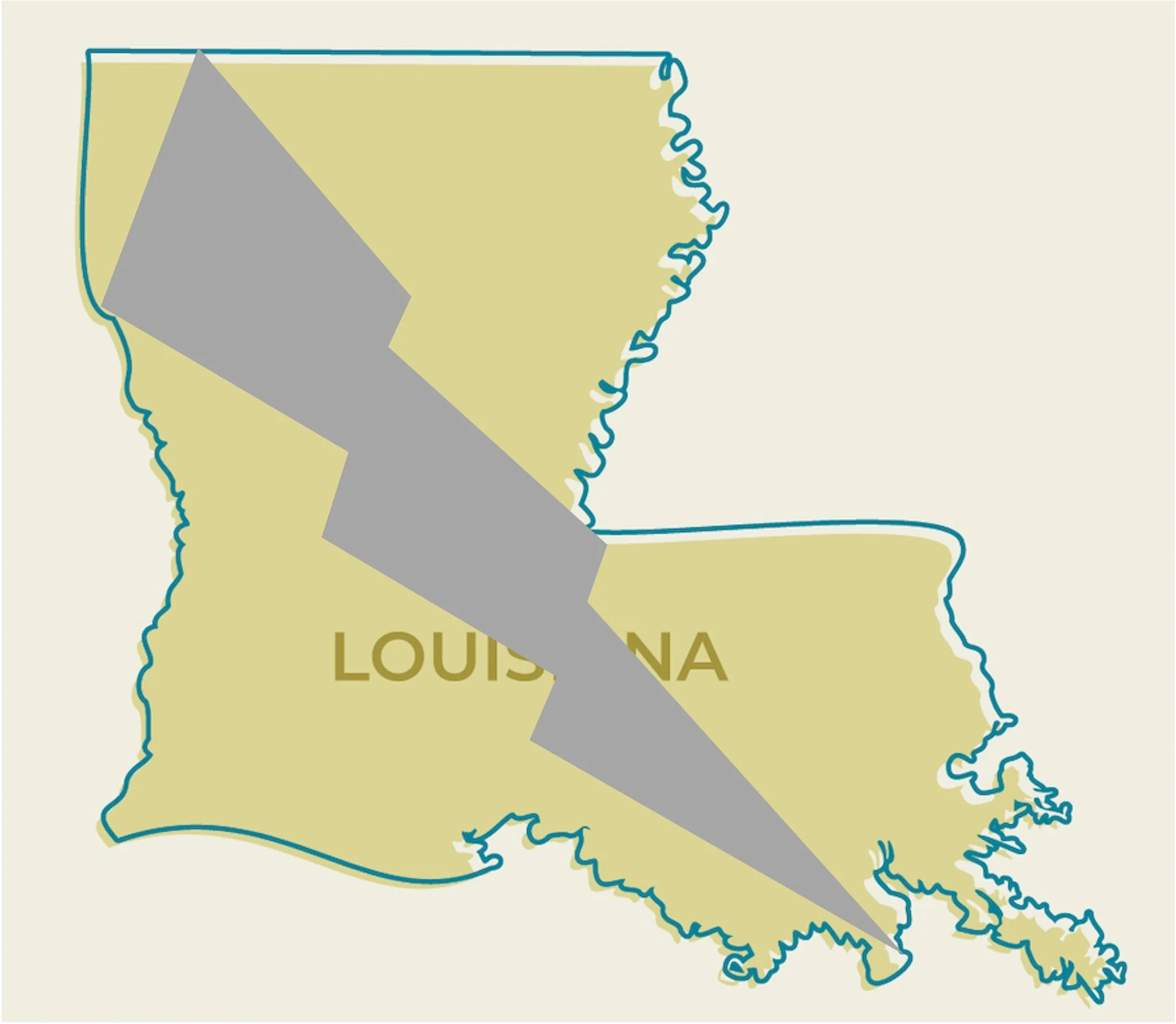
The mission of our self-governing democracy is laid out plainly in the Constitution: to form a more perfect union, establish justice, ensure domestic tranquility, and secure the blessings of liberty. The mechanism we use to pursue that mission is the vote, and open, free, and fair elections comprise the operating system of the entire enterprise. When that operating system is corrupted, everything built on top of it becomes suspect.
This week, three stories out of Louisiana made that truth impossible to ignore. They each look different on the surface: One involves the United States Supreme Court; one involves a governor and a legislature; one involves a man who spent 28 years in prison for a crime he didn't commit. But they all share the same root cause: when given the opportunity, those in power will use their power to stay in power.
The Court Narrows the Guardrail
On April 29, the Supreme Court issued its ruling in Louisiana v. Callais, a 6-3 decision along ideological lines that effectively gutted Section 2 of the Voting Rights Act. [1] The VRA was the law that ended Jim Crow in practice; it gave Black and brown voters ways to counter efforts by state legislatures when maps are designed to dilute their representation.
The Court's majority, written by Justice Samuel Alito, determined that Louisiana's second majority-Black congressional district was an unconstitutional racial gerrymander. [2] The Court did not formally overturn Section 2, but Justice Elena Kagan's dissent noted what the ruling actually did: render it "all but a dead letter." [3] As one analysis put it, the decision "appears to clear the way for Louisiana — and other states — to engage in the discriminatory practice of vote dilution" with far less risk of judicial correction than before. [4]
The practical implication: up to a dozen seats across the South - where the VRA has been the last meaningful check on racially motivated redistricting - could now be redrawn to dilute the political power of Black Americans with limited recourse.
The Governor Suspends the Election
Within 24 hours of the ruling, Louisiana Governor Jeff Landry declared a “state of emergency” and issued an executive order suspending the state's May 16 House primaries - elections that were already underway, with mail-in ballots already in the hands of military and overseas voters. [5][6] Landry framed the move as legal necessity. Critics, including a national election law expert from the Brennan Center, argued the state was under no legal obligation to halt elections already in progress. [7]
The timing tells us a lot. By suspending the primaries, Landry and the Republican-controlled legislature will try to redraw the congressional map and target, in particular, the two majority-Black districts, including the one held by Democratic Rep. Cleo Fields. President Trump applauded the move within hours, thanking the Governor “for moving so quickly” [8] and legislators began signaling they would eliminate at least one of those districts entirely.
A lawsuit was filed the same day, calling the suspension unconstitutional. [9] Early voters saw their ballots threatened. Candidates who had been running for months were thrown into legal limbo. The goal of the suspension is pretty clear: use a judicial ruling as an opening to consolidate political power at the expense of Black voters.
The Elected Clerk Whose Office Was Erased
And then there is Calvin Duncan.
Duncan was convicted of murder in 1981 and spent nearly 30 years in prison before being exonerated - first partially in 2011, and fully in 2021 when a judge found that police officers had lied in court and declared Duncan “factually innocent, expunging the plea from his record.” [10] According to AP, Duncan became a legal expert while still in prison, helping other inmates challenge unconstitutional practices and later became a lawyer. In 2020, Duncan’s legal advocacy drove the U.S. Supreme Court to end non-unanimous jury convictions in Louisiana and Oregon, the only two states still allowing a practice rooted in the Jim Crow era. [11]
In November 2025, the people of New Orleans elected him as Orleans Parish Criminal Court Clerk with 68% of the vote. [12] It was, by any measure, a remarkable story of justice pursued and won.
He was scheduled to be sworn in on May 4, 2026.
Before that day arrived, the Louisiana Legislature passed a bill eliminating the office to which he had been elected. [13] Governor Landry signed it. Attorney General Murrill had previously sent Duncan a letter questioning whether his exoneration was legitimate — a letter that his opponent in the race cited to suggest Duncan was still guilty. [14] When that effort failed at the ballot box, the legislature simply abolished the office.
Duncan filed a federal civil rights lawsuit alleging a conspiracy between Landry and Murrill to block him from taking office in retaliation for his outspoken criticism of a criminal justice system he experienced firsthand. [15] The people of New Orleans voted. Their choice was erased.
The Pattern Is Not New
I have spent nearly 25 years on the Thousand Oaks Planning Commission, and I have written about these types of episodes in Local Democracy in America. [16] The scale is different, but the pattern is not. In Thousand Oaks, I watched efforts to strip voters of their right to weigh in on who represents them - an effort that led me to author the Thousand Oaks Right to Vote Initiative, approved unanimously in 2012. The people of Thousand Oaks had to fight for the right to govern themselves, against the interests of those who preferred the decision be made for them.
The mechanism is universal: when those in power perceive a threat to their position, they reach for the tools available to them - the judiciary, the legislature, the pen of a governor, the rules for whether an election is even needed. The specific tool changes; the impulse does not.
The Decision Environment We Must Protect
I think about these events through the lens of what I call a decision environment - the conditions within which consequential choices get made. For a self-governing society, the most important decision environment we have is the election. When that environment is compromised - when maps are drawn to predetermine outcomes, when elections are suspended for political advantage, when the will of 68% of a city's voters can be nullified by a bill passed in a state capital - the decision environment itself is corrupted.
It is not enough to have the right values if the environment within which decisions are made systematically advantages those who are already in power. Better environments produce better decisions, which produce better outcomes. Worse environments produce the opposite, regardless of individual intelligence or good intentions.
Three stories this week from Louisiana remind us that the defense of our right to vote is not abstract; it is the most concrete work of citizenship.
Give the data the opportunity to change our minds. And when the data show us what is actually happening, it’s up to us to say so.
Notes and Sources
[1] Mark Sherman, “Supreme Court weakens the Voting Rights Act and aids GOP efforts to control the House,” April 29, 2026, https://apnews.com/article/supreme-court-voting-rights-congressional-redistricting-louisiana-aa5d7dbde7c13654f341d152c2ad5229
[2] Louisiana v. Callais, 598 U.S. ___ (2026), https://www.supremecourt.gov/opinions/25pdf/24-109_21o3.pdf
[3] Louisiana v. Callais, 598 U.S. ___ (2026), p 91.
[4] Madeleine Greenberg, “The U.S. Supreme Court Has Eviscerated the Voting Rights Act — What’s Next?” Campaign Legal Center, April 30, 2026, https://campaignlegal.org/update/us-supreme-court-has-eviscerated-voting-rights-act-whats-next
[5] Governor Jeff Landry, “STATE OF EMERGENCY - SUSPENSION OF CLOSED PARTY PRIMARY ELECTIONS FOR THE OFFICES OF REPRESENTATIVE IN THE UNITED STATES CONGRESS,” State of Louisiana, Executive Department, Office of the Governor, Executive Order Number JML 26-038, April 30, 2026, https://www.doa.la.gov/doa/osr/executive-orders/
[6] Dan Merica and Patrick Marley, “Louisiana suspends House primaries as red states face pressure to redistrict,” Washington Post, April 29, 2026, https://www.washingtonpost.com/politics/2026/04/29/louisiana-house-primaries-suspend-jeff-landry/
[7] Piper Hutchinson, “Louisiana governor postpones U.S. House primary elections after Supreme Court ruling,” Louisiana Illuminator, April 30, 2026, https://lailluminator.com/2026/04/30/louisiana-governor-ag-says-they-will-postpone-u-s-house-primaries-following-callais-decision/
[8] Donald J. Trump [@realDonaldTrump], TruthSocial, April 30, 2026, https://truthsocial.com/@realDonaldTrump/posts/116494895594528861
[9] Yunior Rivas, “Louisiana sued for suspending active election, nullifying votes to draft GOP gerrymander,” Democracy Docket, April 30, 2026, https://www.democracydocket.com/news-alerts/louisiana-sued-for-suspending-active-election-nullifying-votes-to-draft-gop-gerrymander/
[10] Joe Jurado, “Exonerated Man Calvin Duncan Wins New Orleans Criminal Clerk Election,” NewsOne, November 18, 2025, https://newsone.com/6620461/exonerated-man-calvin-duncan-elected-new-orleans-criminal-clerk/
[11] Mark Sherman, “Supreme Court: Criminal juries must be unanimous to convict,” Associated Press, April 20, 2020, https://apnews.com/article/a4f065037299491913827b7d8eda9023
[12] Jack Brook, “A New Orleans man who had his murder conviction tossed wins election as city’s chief record keeper,” Associated Press, November 16, 2025, https://apnews.com/article/new-orleans-clerk-calvin-duncan-dc0ca1c86bcc313b4e5af43ed623fa15
[13] Sara Cline and Jack Brook, “Louisiana Republicans eliminate elected position days before an exoneree was set to take office,” Associated Press, May 1, 2026, https://apnews.com/article/new-orleans-criminal-clerk-calvin-duncan-exonerated-6a48a3d1ca81c91d42dc122dbed77f29
[14] Joe Jurado, “Exonerated Man Calvin Duncan Wins,” November 18, 2025
[15] Juan A. Lozano, “Exonerees struggle to rebuild their lives and gain lasting employment, even if elected to office,” Associated Press, April 30, 2026, https://apnews.com/article/exonerees-stigma-employment-dd603de9dafca7078517aea4ae8cfc9e
[16] Mic Farris, Local Democracy in America, Amazon Kindle Direct Publishing, 2025
Decisions with Mic Farris
Seek Truth. Honor Differences.