Trump vs The Press
Donald Trump doesn’t value America’s First Amendment. So, White House correspondents shouldn’t be celebrating the First Amendment with him.
If you’d like these posts delivered directly to you, subscribe to the Decisions newsletter now!
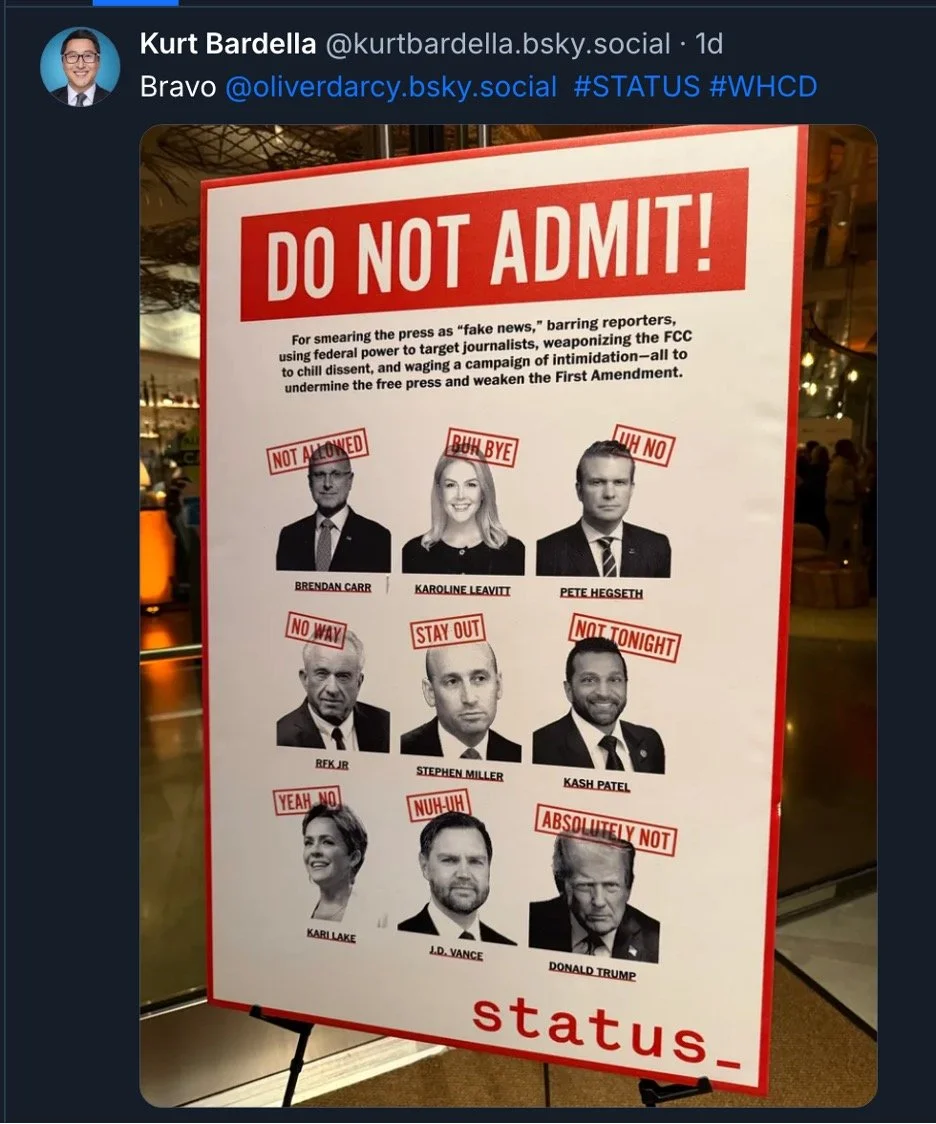
Post by Kurt Bardella, showing the “Do Not Admit!” sign at the Status pre-White House Correspondents’ Dinner event this Thursday [1]
Prelude to the White House Correspondents' Dinner
This past Thursday evening in Washington, two events happened simultaneously — and the contrast tells us everything we need to know about where press freedom stands right now.
At one gathering, CBS News journalists clinked glasses with Donald Trump at an event ostensibly honoring the First Amendment. At the other — hosted by Status, an independent publication founded by CNN’s former senior media reporter, Oliver Darcy — administration officials weren't just uninvited; their photos were posted at the door as a condition of entry. [2] One celebrated the idea of a free press; the other actually demonstrated one.
Let’s put this through the Truth & Consequences lens, because this can help us with this situation.
The Truth
The First Amendment exists for a reason that goes well beyond protecting speech in the abstract. It is the structural foundation for holding power to account: informing the public of what they need to know to govern themselves, protecting the freedom to state what is true and to express one's own view about that truth.
That's the intent, because the American Founders knew that those in power will tend to abuse their power by preventing the truth from coming out if they can do so.
The current administration has been hostile to that intent in ways that are neither subtle nor ambiguous. Reporters have been denied access, and outlets have been targeted. The press has been framed as “the enemy of the people.” [3] These are not matters of political opinion; instead, they are observable, documented behaviors.
So when a room full of journalists celebrates the First Amendment with the President working to undermine it, the assessment of the truth has either been distorted or is being deliberately ignored. And when you choose not to know the truth - or look away from it - bad decision making becomes much easier.
The Consequences
Here's where it gets uncomfortable, because it requires us to look honestly at what's actually driving the decision to show up.
The consequences are not abstract. Newsrooms fear losing White House access. Reporters fear being shut out of briefings. Editors fear being on the wrong side of an administration that has shown it will retaliate. These are real, career-shaping, institution-threatening concerns, and they are being weighed, consciously or not, every time a press organization decides to send representatives to events like this.
This is outcome-based decision making: the consequences of not going are perceived as so significant that almost no amount of truth about what the administration represents changes the calculus. Access is treated as the goal, but it's not; it's only a means to the goal — and when the means requires you to legitimize the very people working against the end you're supposed to serve, something has gone badly wrong.
Honor the Truth Seekers
I've written before about what I call honoring the truth seekers. Scientists, detectives, investigators, journalists — they are all in the same business: finding the best explanation for what we observe and what is happening, even when that explanation is inconvenient, even when no one wants to hear it, even when the consequences for telling it are real and personal.
Organizations and institutions that protect and reward this behavior consistently outperform those that suppress it. The converse is also true: environments that punish truth-telling, that make it more costly to be honest than to go along, degrade both the quality of decision making and the integrity of the people making the decisions.
Status made a different decision. They named the truth and designed their event around it. That's not just a branding choice - it's a decision culture choice. And I think it matters.
The press corps that actually holds power to account is the one that starts with an honest assessment of what power is doing and doesn't let the fear of losing a seat at the table outweigh what that seat is supposed to be for.
Notes and Sources
[1] Kurt Bardella [@kurtbardella.bsky.social], Bluesky, April 23, 2026, https://bsky.app/profile/kurtbardella.bsky.social/post/3mk7eywu5sc2n
[2] Oliver Darcy, “Inside the 2026 Status WHCD Event,” Status, April 25, 2026, https://www.status.news/p/inside-the-2026-status-whcd-event
[3] Brett Samuels, “Trump ramps up rhetoric on media, calls press ‘the enemy of the people’,” The Hill, April 5, 2019, https://thehill.com/homenews/administration/437610-trump-calls-press-the-enemy-of-the-people/
Decisions with Mic Farris
Seek Truth. Honor Differences.