In the advent of AI, we can’t outsource what makes us human – our own thinking and decision making
If you’d like these posts delivered directly to you, subscribe to the Decisions newsletter now!
Henry Mance [@henrymance.ft.com], Bluesky, August 19, 2026, https://bsky.app/profile/henrymance.ft.com/post/3mtgvx7hxbs2h
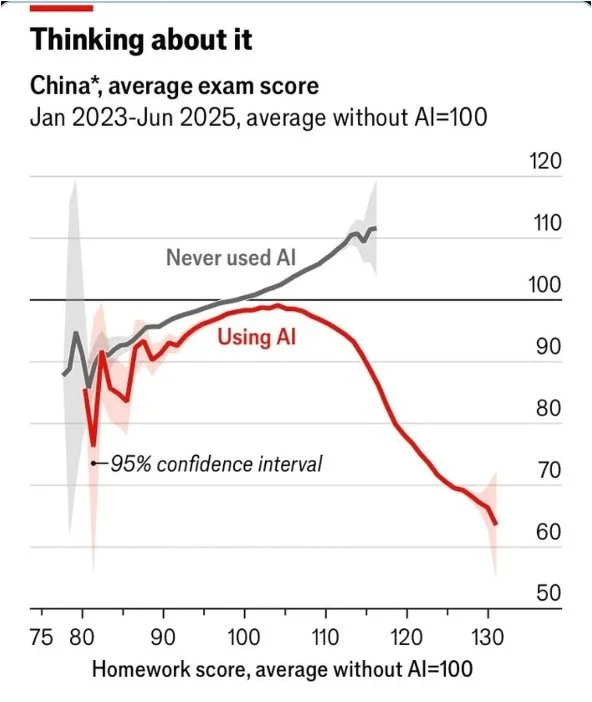
I saw a chart this week that made me think about how AI is being used – both becoming incredibly useful and degrading our ability to think and decide well.
A recently published preprint studied how generative AI affects homework productivity and learning. The researchers used 30 months of data from monthly closed-book exams, high-school and college entrance exams, and homework scores and completion time across nine subjects on 26,811 students in China in grades 7-12. [1]
The researchers studied two sets of students – those that adopt generative AI to complete their homework and those that did not. For the cohort that did not adopt generative AI, the average homework scores were generally in line with the average test scores for the same students – how well the students did on the homework generally matched how well they performed on the tests.
However, for those who adopted generative AI, the results were strikingly different. Those using AI finished their homework about 30% faster and improved these homework results by about 20%. [2] That said, the exam scores for the same students dropped by 20% - plus, on average, the higher the students performed on their homework, the lower those same students performed on the exams. [3]
Basically, students were using the tools to finish their homework, but they weren’t learning – the actual point of education. Their decision making was clearly becoming dependent on the new tool.
This phenomenon isn’t limited to students; lawyers are still making their legal arguments by cutting corners and citing fake cases in their court briefings. A homeowner recently sued her contractor, the contractor’s insurance company, a public adjuster and her homeowners insurance company, State Farm, in this case covered by CalMatters reporting: [2]
A fire in her home in Carson, in Los Angeles County, in 2020 caused her home to become uninhabitable, according to the lawsuit. While her contractor was working on the home, a storm caused water damage. After what she said were delays getting State Farm’s approval for repairs, the work on her home was never completed, according to a January court filing. She and her husband have drained their savings and retirement accounts, declared bankruptcy and lost their home to foreclosure, she wrote.
In the course of the case, the homeowner’s lawyers called out issues with the motions filed by State Farm in an August 7 conference in Los Angeles Superior Court, stating that the “cases that do not exist, quotes that do not exist, and holdings that do not exist.” [4] The State Farm attorneys were “‘visibly enraged’ afterward and followed him and his co-counsel down the hall, ‘repeatedly demanding to see the list’ of mistakes they had found.” The State Farm attorney later had to apologize to the court. [5]
Unfortunately, the issue is widespread, as noted from this May 2026 article in Scientific American: [6]
In April the Alabama Supreme Court sanctioned an attorney who had filed legal briefs laden with inaccurate citations generated by AI, including numerous references to cases that did not exist. After being informed he had cited a made-up precedent in one filing, the lawyer promised it wouldn’t happen again—but then cited “nonexistent cases at the end of the very next sentence,” as a justice noted in a concurring opinion. At least one other lawyer was sanctioned that week for continuing to file AI-hallucinated material after being warned not to do so.
A database maintained by Damien Charlotin, a senior research fellow at the Paris School of Advanced Business Studies (HEC Paris), lists more than 1,400 cases where courts have addressed AI errors in the past three years, including filings by attorneys and self-represented litigants. As recently as last fall, Charlotin says, the list appeared to be growing exponentially. It’s since leveled off to a steady flow of exasperated judicial rulings. “For the past two or three months, we have reached a plateau of around 350, 400 decisions a quarter,” says Charlotin, who has also created an AI-powered reference checker called Pelaikan.
Bottom line: We have to own our decision making, and we should strive to become better thinkers and smarter decision makers. Using a tool to get the information fast can be helpful, but we shouldn’t outsource what we should think or what to do because the machine told us so.
Our decisions are in fact ours, whether we choose to own them and take full responsibility or we choose to just parrot what the AI chatbot told us.
To make better decisions, check the sources and feel confident that they are providing you good information.
By the way, this goes for people, too - just because someone says something doesn’t mean you shouldn’t double check yourself. This isn’t new with AI…
If you’re just passing information someone told you without validating or checking on your own, it’s just kind of lazy. Yes – it’s certainly slower and may seem less efficient, but it builds trust from others if what you convey is the truth and not merely something that someone else said.
For students, the goal is to learn, not to finish homework tasks.
For lawyers, the goal is to support your argument, not to base conclusions on made-up information.
For us, the goal is to be a better decision maker. It’s pretty natural to place blame elsewhere when things go wrong, but it’s more important than ever to take full ownership in what our point of view is.
Our decisions are ours anyway – best to make them good ones.
Notes and Sources
[1] David Stromberg, Victor Lei, and Yanhui Wu, “The Generative AI Learning Penalty: Evidence from Chinese Secondary Education,” preprint, June 2, 2026, https://papers.ssrn.com/sol3/papers.cfm?abstract_id=6868618, p. 1.
[2] Ibid., p. 31.
[3] Ibid., p. 46.
[4] Levi Sumagaysay, “State Farm defense lawyers admit AI generated fake cases in LA lawsuit,” CalMatters, August 18, 2026, https://calmatters.org/economy/2026/08/state-farm-lawsuit-ai-hallucinations/
[5] Ibid.
[6] Steven Melendez, “AI keeps inventing fake cases. Lawyers keep citing them,” Scientific American, May 22, 2026, https://www.scientificamerican.com/article/why-lawyers-keep-citing-fake-cases-invented-by-ai/
Decisions with Mic Farris
Seek Truth. Honor Differences.