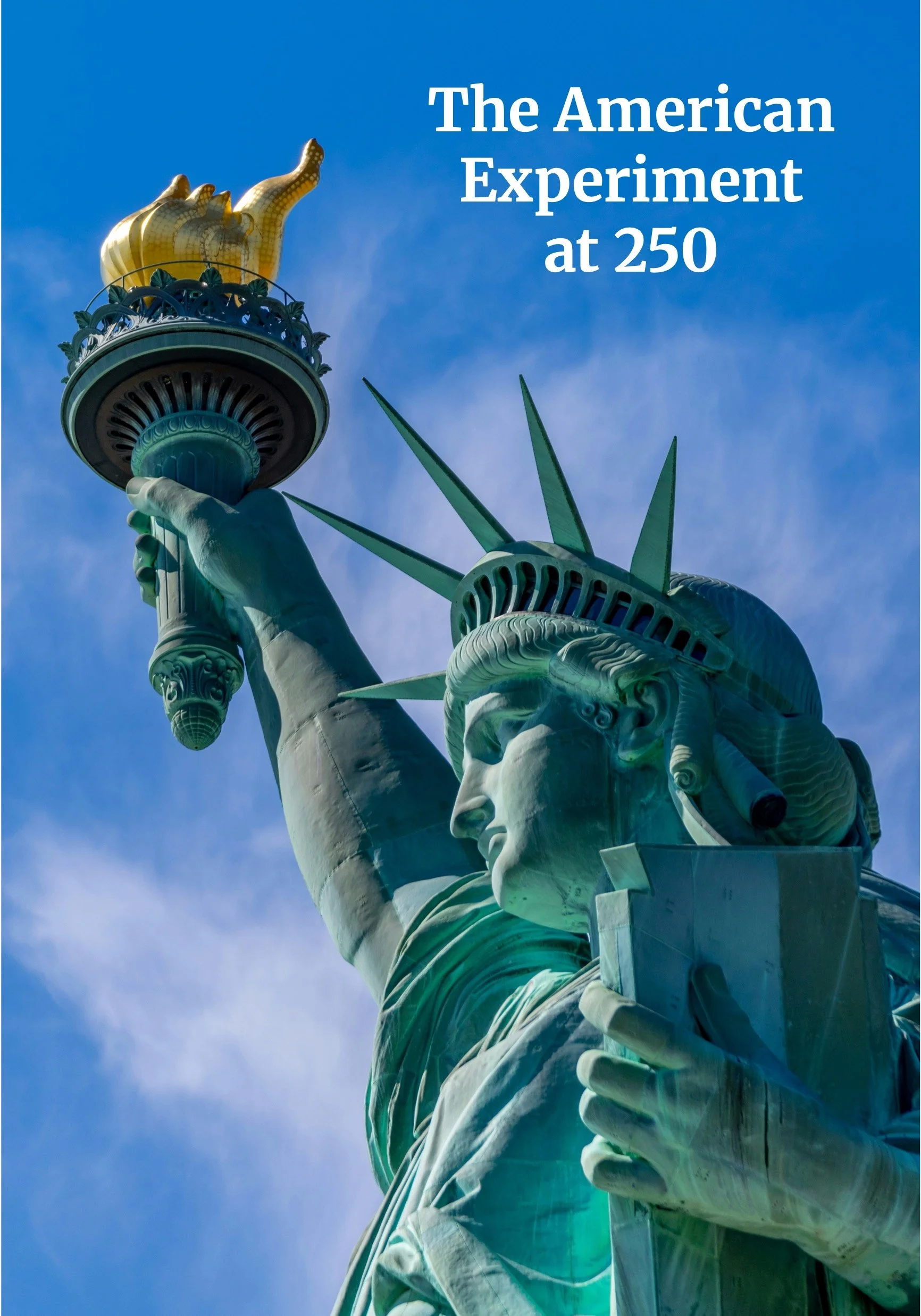
The American Experiment
Remembering what made and makes America America.
If you’d like these posts delivered directly to you, subscribe to the Decisions newsletter now!
250 years ago today, these words served to found a new nation, launching an ongoing experiment in how people would govern themselves: [1]
In Congress, July 4, 1776
The unanimous Declaration of the thirteen united States of America, When in the Course of human events, it becomes necessary for one people to dissolve the political bands which have connected them with another, and to assume among the powers of the earth, the separate and equal station to which the Laws of Nature and of Nature's God entitle them, a decent respect to the opinions of mankind requires that they should declare the causes which impel them to the separation.
We hold these truths to be self-evident, that all men are created equal, that they are endowed by their Creator with certain unalienable Rights, that among these are Life, Liberty and the pursuit of Happiness.--That to secure these rights, Governments are instituted among Men, deriving their just powers from the consent of the governed…
The American Experiment is one of choosing to govern ourselves. Prior to this, stories were told, such as the divine right of kings, justifying why those in power should rule over those who were not. The Revolution, the Declaration, and the ongoing American Experiment flipped that on its head, rightly declaring for the world to hear that people had the right to determine for themselves their own method of self-government.
While many essays and posts will focus on the quarter-millennium of American independence, I want shine a light on the recent Supreme Court ruling on the meaning of the Fourteenth Amendment - and how that relates to this very journey of self-governance we started 250 years ago.
On June 30, the Supreme Court decided Trump v. Barbara, and the vote broke down further than the topline 6–3 suggests: shockingly, only five justices agreed the President's executive order was unconstitutional. Chief Justice John Roberts wrote for the majority, [2] and the holding was not complicated:
In America, if you're born here and subject to our laws, you're an American citizen.
After the Civil War ending slavery in America, the Fourteenth Amendment was written to close a debate - permanently. Before it, the country had litigated who counted as a citizen through Dred Scott, through decades of state-by-state improvisation, through a Civil War.
The Reconstruction Congress set the floor to end the debate forever: born here, subject to our laws, citizen. You can become a citizen other ways, too, but nobody - not a state legislature, not a future Congress, not an executive order - gets to keep reopening the floor.
Some of the same post-Reconstruction forces that wanted to deny Black Americans their rights as equal citizens are rearing their heads again, now targeting disfavored sets of immigrants.
And let’s keep ourselves wide-eyed about this - this isn’t limited to undocumented immigrants; we're already seeing an appetite for denaturalization, for stripping citizenship from people who did every step correctly - very different from President Ronald Reagan’s speech, considered a “love letter to immigrants.” [3][4][5]
There’s an effort to relitigate for who really “deserves” to be an American. It's a decision environment where the rights you and I may have are only as stable as the last election.
While the text of the Fourteenth Amendment and the Court majority’s argument is clear, Justice Ketanji Brown Jackson's concurrence goes further in settling the case. [6] Her argument: the Reconstruction Amendments weren't a narrow fix for slavery. She frames them as what she calls an anticaste, antisubordination reset for the entire nation - a second Founding, not a patch.
And she closes with something more pointed than a legal footnote. She points out that the government's own position, if you follow it to its root, lands right back on the core premise of Dred Scott: that for some people, being born here would never be enough. She calls that conclusion odious, and I'd say it’s a preview of where this fight goes next if nobody holds the line.
If you want to go deeper, Jackson's footnotes gave us a syllabus. Eric Foner's Reconstruction: America's Unfinished Revolution [7] and The Second Founding [8] are the two books I'd start with - they're greats accounts of how the post-Civil War amendments were meant to remake the country, not just repair it. David Blight's Frederick Douglass: Prophet of Freedom [9] gives you the human center of that fight. And Isabel Wilkerson's Caste [10] is the one that connects Reconstruction's unfinished work to the hierarchy still running underneath American life today.
We're 250 years past the Declaration, and the line about all men being created equal is profound and yet unfinished. It was written by men who didn't mean it as broadly as we now insist it be read - and every generation since gets to redeclare it, expand it, and fight for what it actually requires. That’s what the Americans of the post-Civil War era did with the Fourteenth Amendment, becoming new Founders.
Throughout our American Experiment, we are all Founders; with each generation, we get to continue the Experiment. Of all the things upon which we can agree as Americans, I’d like to think that the American Experiment of self-governance is worth pursuing and continuing.
Notes and Sources
[1] Declaration of Independence, July 4, 1776, https://www.archives.gov/founding-docs/declaration-transcript
[2] Trump v. Barbara, 609 U.S. ___ (2026), June 30, 2026, https://www.supremecourt.gov/opinions/25pdf/25-365_4hdj.pdf
[3] Mic Farris, “A Hopeful Message (+No Kings!),” June 15, 2025, https://www.micfarris.com/articles/a-hopeful-message-no-kings
[4] “NowThis Impact,” Facebook, February 17, 2020, retrieved July 3, 2026, https://www.facebook.com/watch/?v=536234913683330
[5] “Remarks at the Presentation Ceremony for the Presidential Medal of Freedom,” January 19, 1989, retrieved from Ronald Reagan Presidential Library & Museum July 3, 2026, https://www.reaganlibrary.gov/archives/speech/remarks-presentation-ceremony-presidential-medal-freedom-5
[6] Trump v. Barbara, https://www.supremecourt.gov/opinions/25pdf/25-365_4hdj.pdf#page=32
[7] Eric Foner, Reconstruction Updated Edition: America's Unfinished Revolution, 1863-1877, HarperPerennial, New York, 1988, https://www.amazon.com/Reconstruction-Updated-Unfinished-Revolution-1863-1877/dp/0062354515
[8] Eric Foner, The Second Founding: How the Civil War and Reconstruction Remade the Constitution, W. W. Norton & Company, New York, 2019, https://www.amazon.com/Second-Founding-Reconstruction-Remade-Constitution/dp/0393358526/
[9] David W. Blight, Frederick Douglass: Prophet of Freedom, Simon & Schuster, New York, 2018, https://www.amazon.com/Frederick-Douglass-David-W-Blight/dp/1416590323
[10] Isabel Wilkerson, Caste: The Origins of Our Discontents, Random House, New York, 2020, https://www.amazon.com/Caste-Origins-Discontents-Isabel-Wilkerson/dp/0593230272
Decisions with Mic Farris
Seek Truth. Honor Differences.