Civic Decision Intelligence
Public decision quality is a function of the decision environment, not just the decision makers.
If you’d like these posts delivered directly to you, subscribe to the Decisions newsletter now!
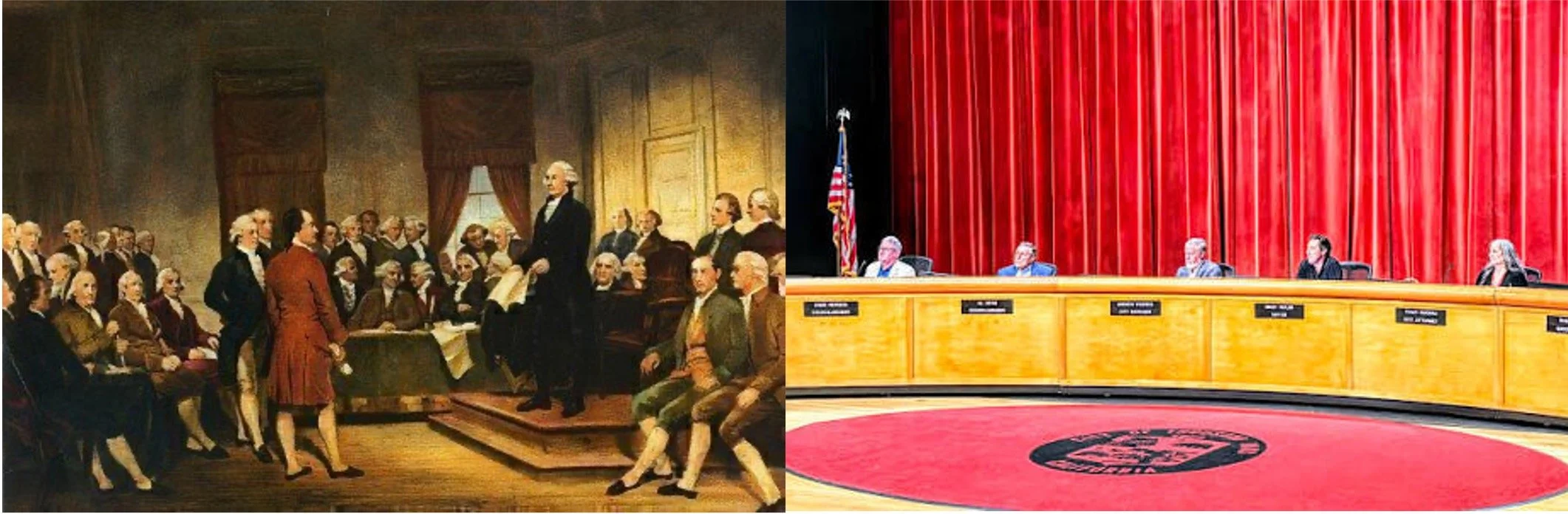
Philadelphia, summer 1787. No air conditioning, windows shut to keep the debates private, fifty-five men arguing for months over a question that sounds almost too simple to need a convention: Who gets to decide, and how do we stop them from deciding badly?
Of course, that constitutional convention was formed to determine how disparate decision makers from across an expansive republic should form a national government - one that is effective yet also prevents tyranny. They didn't trust any single answer to that question - not a king, not a legislature, not even a future version of themselves.
So they built something slower on purpose. Three branches, each checking and balancing the others. A House answerable every two years, a Senate insulated from immediate passions to act in the long term, a Presidency tasked with faithfully executing the laws, and courts to handle cases and controversies when inevitable disagreements arise.
While there were compromises – some convenient, others appalling – the construction of the branches was not an accident; that's a specifically engineered decision environment. Through research into history, [1][2] they understood how decision makers behave and worried greatly about abuses of power. They distributed the centers of power and of decision making itself across the branches – legislative, executive, and judicial – as well as away from these branches altogether – keeping certain power away from a national government and with states and the people.
Civic Decision Intelligence is the application of decision-culture frameworks - the same ones I use to diagnose why a leadership team keeps making the same bad call - to how a government, a council, or a commission actually decides. The starting premise is the one I keep coming back to in corporate rooms too: decisions aren't good or bad purely because the people in the room are smart or foolish; they can become good or bad because of the environment those people are deciding within.
The Constitution is the first long-lasting American proof of that premise at the national scale. The Framers assumed power would be abused if it could be - not might be, would be - and built a structure where abuse is expensive and slow rather than free and fast. Less efficient by design.
I've actually watched the same mechanism play out at a scale you may never read about in a textbook.
In 2012, Thousand Oaks had a quiet structural problem. For the second time in a seven-year period, when a City Council seat opened mid-term, the remaining Councilmembers simply appointed the replacement. No vote of the people - just a majority vote among the people already on the dais. The initiative I authored that year to end that practice said plainly what was actually happening: [3]
"The unchecked authority to fill Council vacancies through appointment has allowed a simple Council majority to handpick like-minded members in order to keep and expand their political power."
People with the power to decide who joins them will, eventually, use that power to protect themselves rather than to serve the people. The remedy wasn't a better Council; it was a better decision environment - pulling the vacancy decision out of the Council’s hands and putting it back where it belonged - in the hands of the voters.
To me, this is the part of what I do that has impact. Decisions driven by keeping power aren’t the best decisions. I've sat in rooms with executives and among decision makers on a planning dais, and the driving forces don't change - only the stakes and the audience do. A council, a commission, a Congress: each one is just a decision environment somebody built, on purpose or by accident, and every environment is either making good decisions easier or making them harder.
Whether locally or nationally, adjusting that environment is worth doing to keep our eyes on serving the public well.
Notes and Sources
[1] Alexander Hamilton and James Madison, “The Same Subject Continued: The Insufficiency of the Present Confederation to Preserve the Union,” Federalist Papers No. 18, 1787, https://guides.loc.gov/federalist-papers/text-11-20#s-lg-box-wrapper-25493289
[2] Alexander Hamilton, “The Utility of the Union as a Safeguard Against Domestic Faction and Insurrection,” Federalist Papers No. 9, 1787, https://guides.loc.gov/federalist-papers/text-1-10#s-lg-box-wrapper-25493272
[3] Ordinance No. 1580-NS, Thousand Oaks City Council, adopted July 17, 2012, https://weblink.toaks.org/WeblinkPublic/DocView.aspx?id=1140924&dbid=0&repo=CTO
Decisions with Mic Farris
Seek Truth. Honor Differences.