The Maps Send The Message
Fast-moving efforts to redraw district maps are sending a message. We have work to do to ensure we’re sending the right one.
If you’d like these posts delivered directly to you, subscribe to the Decisions newsletter now!
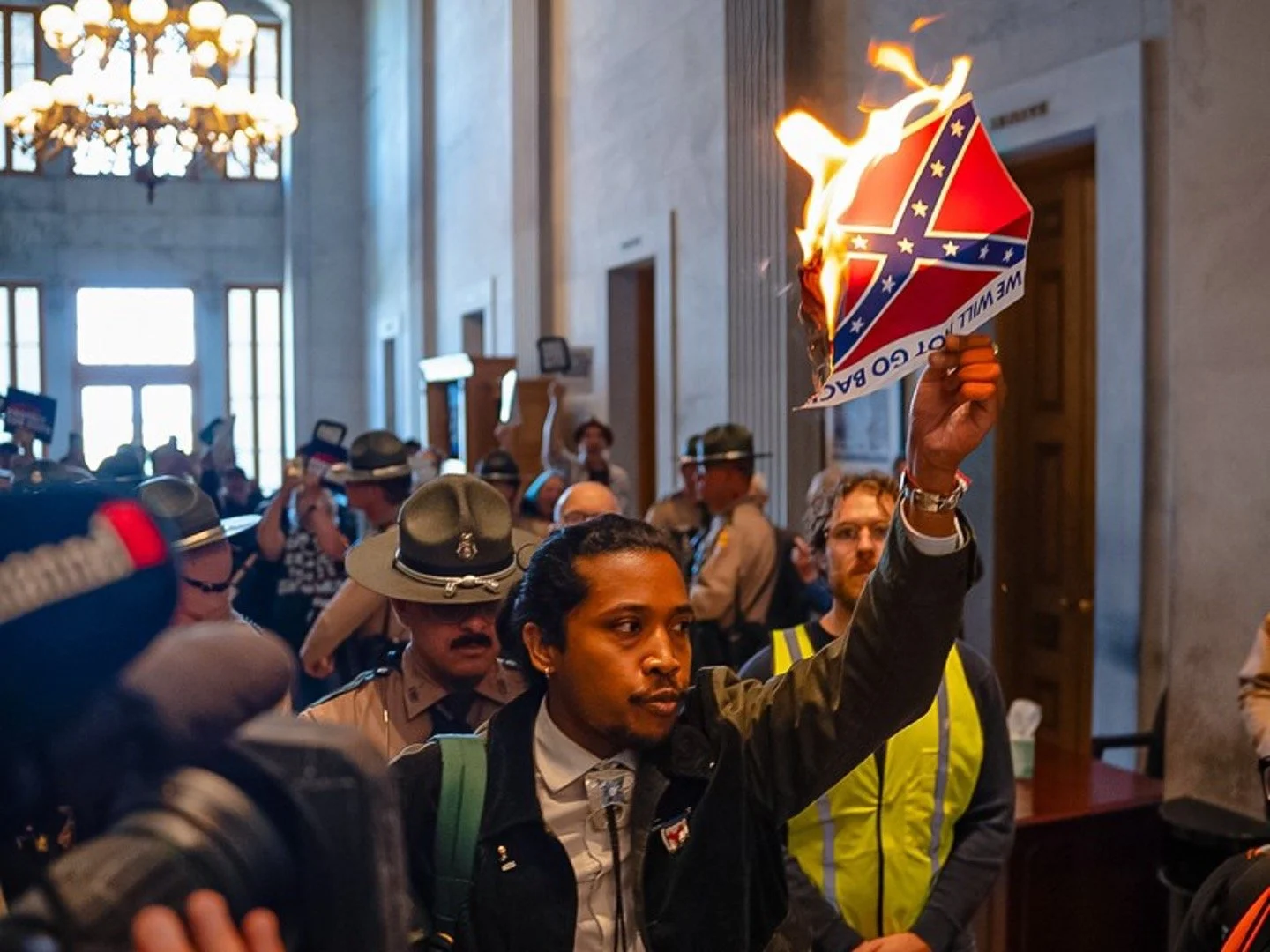
Rep. Justin Jones (D-Nashville) burns a paper replica of a Confederate flag as he walks through a state Capitol hallway on Thursday. Credit: Martin B. Cherry / Nashville Banner
Last week, a Tennessee state representative walked out of the House chamber and burned a picture of the Confederate flag. The words on the image read: "We Will Not Go Back." [1][2]
He was responding to the signing of a new congressional map that carved up the lone Democratic-held district in the state - a Black-majority district anchored in Memphis - eliminating the political representation of hundreds of thousands of Tennessee citizens. A similar story is unfolding in Louisiana, Alabama, South Carolina, Florida, North Carolina, and Texas. [3] In each case, state governments are redrawing congressional lines to dilute or eliminate districts with large minority populations - districts that had been protected, explicitly, under the Voting Rights Act.
I tend to think of this as a decision culture problem.
Every decision reflects what the decision maker truly values. Not what they say they value - what they actually value, revealed by the choices they make when the consequences are on the table.
And further, here is the question worth asking about what is happening across the former Confederate states right now:
Do we value every American as created equal and therefore treat them as equal in their right to determine their own representation? Or do we assign greater value to the concentrated authority of those already in power, so they can keep it?
The Reconstruction Amendments were written precisely because a collection of American states had answered that question in the most catastrophic way imaginable. Those amendments, along with the Voting Rights Act of 1965, were the structural interventions that followed: guardrails built into our democracy to ensure that the equality promised in our founding documents was not simply aspirational language.
They were not suggestions. They were corrections of error - a term I use a lot in the context of organizational decision making. It’s important to identify the root cause of the failure and put structural mechanisms in place to prevent it from recurring. This protects the integrity of the decision environment.
What is happening in Tennessee, Florida, Louisiana, Alabama, South Carolina, Texas, and North Carolina right now is the dismantling of those mechanisms, using the levers of power to redraw who gets to pull the levers of power. This is outcome-based decision making at its most transparent: the desired outcome is maintaining control, and the analysis is constructed to justify it. When a state eliminates a Black-majority congressional district that existed because the Voting Rights Act required it, the decision maker is not asking "what does equality require?" They are asking "what does our continued advantage require?"
These are not the same question. And the difference matters enormously.
I've spent decades noticing that the health of any organization - a company, a city, a democracy - depends on getting the decision culture right. The failure mode I see in boardrooms and city halls is identical: when those in power design the decision environment to favor their own continued power rather than the best outcomes for the whole, the system degrades.
What is being built in the former Confederate states right now is a decision environment deliberately engineered to suppress the equal participation of certain American citizens in the decisions that govern their lives. History has a name for that, and we spent more than a century trying to correct it. The guardrails we built were not perfect, but they were real, and they were working.
The representative who burned that flag was honoring the truth. The map that prompted him to do it was designed to obscure it.
We should care about which one wins - not as partisans, but as people who believe that better decision environments produce better outcomes for everyone. A democracy that suppresses the equal voice of its citizens is not a democracy that will result in good decisions for our people.
Notes and Sources
[1] NewsChannel 5 Nashville [@newschannel5], Facebook, May 7, 2026, https://www.facebook.com/watch/?v=1286760763546463
[2] Sarah Grace Taylor, “Tennessee Passes Redistricting Map, Arrests Protesters in Final Day of Special Session Marked by Burning Flag, Walkouts,” Nashville Banner, May 7, 2026, https://nashvillebanner.com/2026/05/07/tennessee-congressional-redistricting-confederate-flag/
[3] David A. Lieb, “A state-by-state guide to the redistricting fight,” PBS News, May 8, 2026, https://www.pbs.org/newshour/politics/a-state-by-state-guide-to-the-redistricting-fight
Decisions with Mic Farris
Seek Truth. Honor Differences.