United States of Amathia
Progress comes from choosing to learn, not being willfully ignorant
If you’d like these posts delivered directly to you, subscribe to the Decisions newsletter now!

Amathia and Socrates
Scientists inherently want to know more. We ask “why” constantly, seeking explanations for what we see and what drives these observations.
Likewise, successful businesses always want to know how they can improve their operations, making the machine of delivering value more effective.
But making decisions based too much on vibes and feelings can lead decision makers to be less curious and to avoid knowledge that can lead to better decisions.
Choosing not to know or being willfully ignorant is what’s called “amathia.” This isn’t the same as being ignorant due to being unable to understand; it’s a choice - avoiding knowledge to make the decision maker feel better about what they know is likely wrong.
Here is some background about the origin of this difference from CCNY Professor Massimo Pigliucci: [1]
According to Socrates, the only evil is ignorance. This phrase has always been controversial, because it seems to be immediately refuted by the very well known fact that lots of people do bad things in full knowledge of what they are doing.
…
Now [ancient Athenian political leaders] Pericles and Alcibiades were not ignorant. On the contrary, they were among the most highly educated of Athenians. They were also not stupid. Again, we are talking about two brilliant minds. And they did what they did, in particular with regard to the eventually disastrous conduct of the Peloponnesian War by Athens, in full knowledge. Moreover, when Alcibiades repeatedly switched sides – from Athens to Sparta, then back to Athens, then to the Persians – he knew that he was doing something that his fellow citizens would consider wrong. But he thought so highly of himself, almost a god walking among men, that he felt entitled to do it. From his point of view, whatever course of action he decided on was the right one.
Socrates, of course, understood all too well that smart, educated and ambitious people are particularly prone to suffer from amathia, a sort of willful lack of wisdom. And he also knew that this condition typically leads not just to such people’s ruin, but to the ruin of entire populations that follow them (often out of mere ignorance or stupidity, i.e., agnoia).
“Amathia” is a choice – an active decision not to question things, not to learn, not to be open to having their minds changed.
Conversely, curiosity is the ingredient of progress - asking questions for the purpose of understanding; this is what successful scientists and business leaders do. This is different from the recent “just asking questions” crowd who are really trolling to somehow demonstrate their perceived intelligence over others. Here’s a brief description of “just asking questions” that describes the difference: [2]
"Just Asking Questions" is a pseudoskeptical tactic often used by conspiracy theorists to present false or distorted claims by framing them as questions. If criticized, the proponent of such a claim may then defend themselves by asserting they were merely asking questions which may upset the mainstream consensus. The name of the tactic is therefore derived from the typical response of "I'm not saying it was necessarily a conspiracy; I'm just asking questions." In The Skeptics' Guide to the Universe, Steven Novella distinguishes [Just Asking Questions] from scientific skepticism by explaining that: [3]
[W]hen true scientists ask a question, they want an answer and will give due consideration to any possibilities. Deniers, on the other hand, will ask the same undermining questions over and over, long after they have been definitively answered. The questions—used to cast doubt—are all they are interested in, not the process of discovery they're meant to inspire.
A 2023 study investigated the behavior of willful ignorance, showing that: [4]
When given the choice to learn how their actions will affect someone else, 40% of people will choose ignorance, often in order to have an excuse to act selfishly, according to research published by the American Psychological Association.
From the original 2023 Psychological Bulletin paper: [5]
People often “look the other way” and avoid information about the negative consequences of their actions to maximize personal outcomes. Known as willful ignorance, such behavior is a corrosive force that reduces altruistic behavior across a range of contexts. For instance, consumers may avoid information about the ethical origins or production process of the merchandise they purchase. Similarly, citizens are often reluctant to engage with information about climate change’s impact, so they will not feel obligated to change their lifestyle. Willful ignorance also facilitates corruption in politics and business. In an in-depth analysis of the Watergate scandal, “Participants showed intense faith in the immunizing power of deliberate ignorance.” In the Enron trial, the largest corruption case in U.S. history, the concept of willful ignorance played a key role in the sentencing of top executives.” [internal citations omitted]
And this willful ignorance is infecting our national leadership. House Speaker Mike Johnson appears to exhibit Olympic-level amathia - from The Guardian: [6]
The US House speaker, Mike Johnson, has developed a go-to response when asked about something controversial Donald Trump or members of his administration said or did.
It’s some version of “I don’t know anything about that.”
When pressed about the latest scandal from the Trump administration, Johnson, a Republican from Louisiana, frequently says he is not aware of that news – including last week to reports about a US military strike on an alleged drug boat that has roiled Washington politics.
In comparison with previous speakers, who oversaw House proceedings and worked to hold the executive branch accountable, Johnson’s approach is both extraordinary and an abdication of that position’s traditional responsibility, according to experts on the US Congress.
“It’s pretty unusual for a speaker to plead ignorance about what the commander in chief is doing, especially as often as Speaker Johnson,” said Matthew Green, a politics professor at the Catholic University of America who wrote a book about the former House speaker Newt Gingrich. “The president is a pretty high-profile figure in Washington politics, and this president in particular is a master of getting attention.”
While politicians often avoid answering questions, Johnson’s habit of doing so is particularly noteworthy because of the prominent place the speaker occupies in government, according to the experts on the legislature.
“Very few officers are mentioned specifically in the constitution; the speakership is one of them,” Green said. “I would say it’s absolutely the responsibility of the speaker to keep up with what the president is saying and doing.”
But there are at least 14 examples of Johnson saying he had not heard about or had time to review information on a development from the Trump administration that grabbed front-page headlines and went viral on social media. These include questions about people pardoned by Trump, Immigrations and Customs Enforcement, and the president’s financial dealings and handling of the military.
In May, Trump hosted a private dinner for people who won entry by being the top investors in his memecoin, which raised questions about whether he was using his public office for personal financial gain.
When the CNN host Jake Tapper told Johnson, “I really have a difficult time imagining that if this was a Democratic president doing the exact same thing, you wouldn’t be outraged,” Johnson claimed ignorance.
“I don’t know anything about the dinner. I was a little busy this past week, as you know, getting the reconciliation package over the line, so I’m not going to comment on something I haven’t even heard about,” Johnson said.
Then in October, Trump pardoned a crypto executive, Changpeng Zhao, who was convicted of money laundering, which again drew scrutiny, not just because of the Trump family’s investment in the industry but also because the president said on 60 Minutes: “I don’t know who he is.”
A reporter asked Johnson if, given his criticism of President Joe Biden for allegedly using an autopen to sign pardons and argument that he did not know what he was doing, he was also concerned about Trump saying he did not know Zhao.
“I don’t know anything about that. I didn’t see the interview,” said Johnson, who also claimed that he didn’t “know anything” about a January 6 rioter pardoned by Trump who then was arrested for threatening to kill the House minority leader, Hakeem Jeffries.
By acknowledging what Trump said, he would have to take responsibility for his responses. However, by stating that he hadn’t heard about it or didn’t read the posts, he rationalizes his decisions – he can’t be blamed for terrible decisions [7] since he didn’t have full knowledge.
Johnson is, however, not stupid; he seems to be fully aware of being actively ignorant of facts so that he doesn’t have to face consequences for his responses.
He likely knows what he’s doing, and this is what Socrates was highlighting.
To make better decisions, we need to feel comfortable with knowing the actual truth and consequences of our actions. And that means that, in America, knowing our full history – both the aspirational and the regrettable – inform us to make better decisions now and in the future. Making good decisions means being open to all the information that could be helpful to that decision.
Willful ignorance is a choice – one that weighs comfort higher than making better decisions – placing feelings over facts. [8]
It’s never too late to fight that urge.
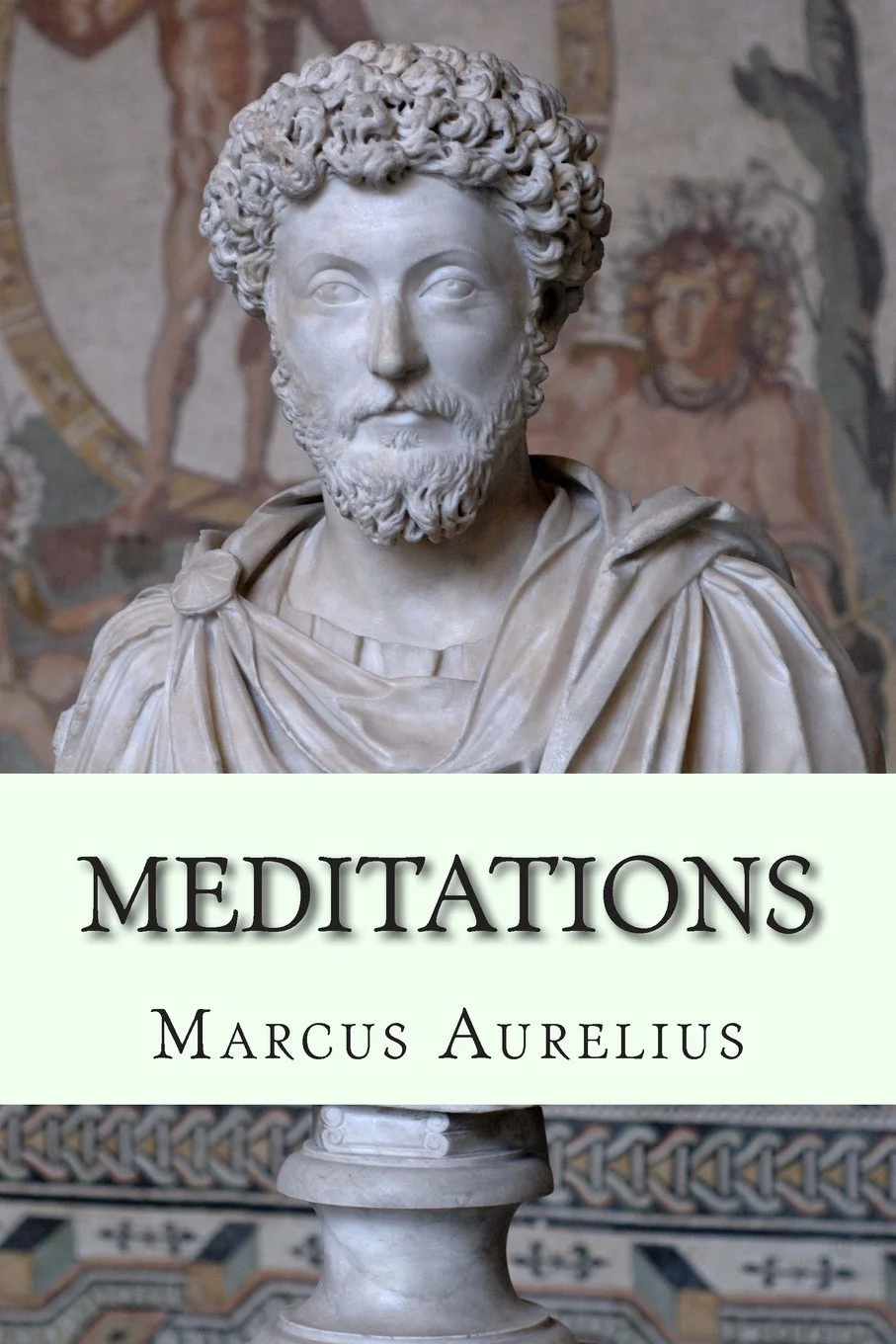
From the Amazon overview [9]:
Meditations is a series of personal writings by Marcus Aurelius, Roman Emperor 161–180 CE, setting forth his ideas on Stoic philosophy.
Marcus Aurelius wrote the 12 books of the Meditations in Koine Greek as a source for his own guidance and self-improvement. It is possible that large portions of the work were written at Sirmium, where he spent much time planning military campaigns from 170 to 180. Some of it was written while he was positioned at Aquincum on campaign in Pannonia, because internal notes tell us that the second book was written when he was campaigning against the Quadi on the river Granova (modern-day Hron) and the third book was written at Carnuntum.
It is not clear that he ever intended the writings to be published, so the title Meditations is but one of several commonly assigned to the collection. These writings take the form of quotations varying in length from one sentence to long paragraphs.
GIF Game
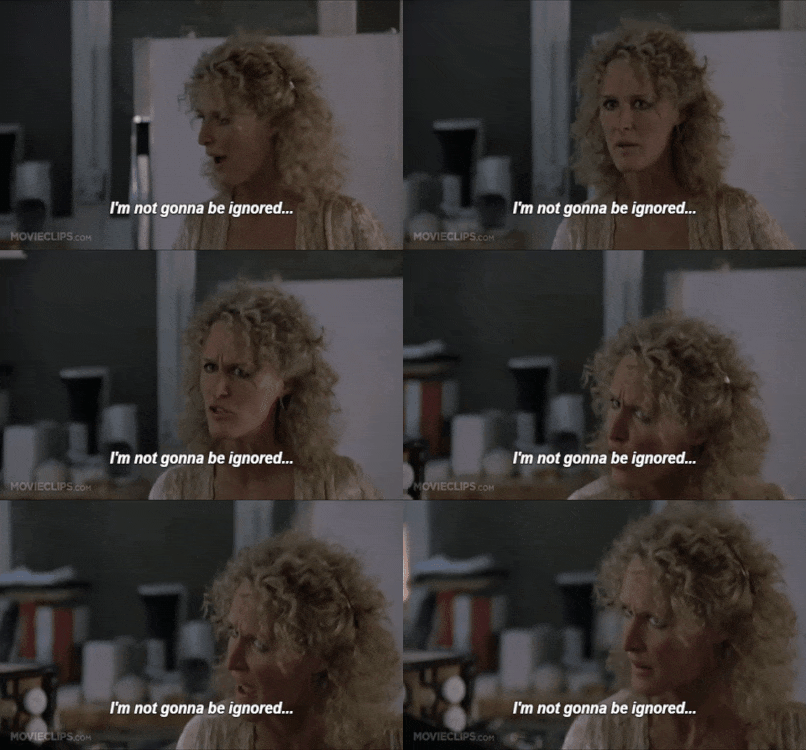
A message from truth and consequences to decision makers…
[Glenn Close in Fatal Attraction]
Notes and Sources
[1] Massimo Pigliucci, “There Is Nothing Banal about Philosophy by Massimo Pigliucci,” Modern Stoicism, January 12, 2019, https://modernstoicism.com/there-is-nothing-banal-about-philosophy-by-massimo-pigliucci/
[2] “Just Asking Questions,” Wikipedia, retrieved December 21, 2025, https://en.wikipedia.org/wiki/Just_Asking_Questions
[3] Dr Steven Novella, The Skeptics' Guide to the Universe: How to Know What's Really Real in a World Increasingly Full of Fake. Grand Central Publishing. p. 202.
[4] “Choosing Ignorance: 40% Shun Consequence Knowledge for Selfish Gains,” NeuroscienceNews.com, October 20, 2023, https://neurosciencenews.com/ignorance-selfish-altruism-24974/
[5] Linh Vu, Ivan Soraperra, Margarita Leib, Joël van der Weele, and Shaul Shalvi, “Ignorance by Choice: A Meta-Analytic Review of the Underlying Motives of Willful Ignorance and Its Consequences,” Psychological Bulletin, 149(9-10), 611–635, 2023, https://psycnet.apa.org/fulltext/2024-16890-004.html
[6] Eric Berger, “Ignorance is BS: speaker’s stock answer on Trump’s misdeeds is ‘I don’t know’,” The Guardian, December 8, 2025, https://www.theguardian.com/us-news/2025/dec/08/mike-johnson-donald-trump
[7] Mic Farris, “Terrible Decisions,” December 14, 2025, https://www.micfarris.com/articles/terrible-decisions
[8] Mic Farris, “Feelings Over Facts,” August 2, 2025, https://www.micfarris.com/articles/feelings-over-facts
[9] Marcus Aurelius, Meditations, https://www.amazon.com/Meditations-Marcus-Aurelius/dp/1503280462
Decisions with Mic Farris
Seek Truth. Honor Differences.