Choosing to Know
An appreciation post for MS NOW’s Ali Velshi on seeking and surfacing truth - book banning, Juneteenth, scientific research – and making us all better decision makers.
If you’d like these posts delivered directly to you, subscribe to the Decisions newsletter now!
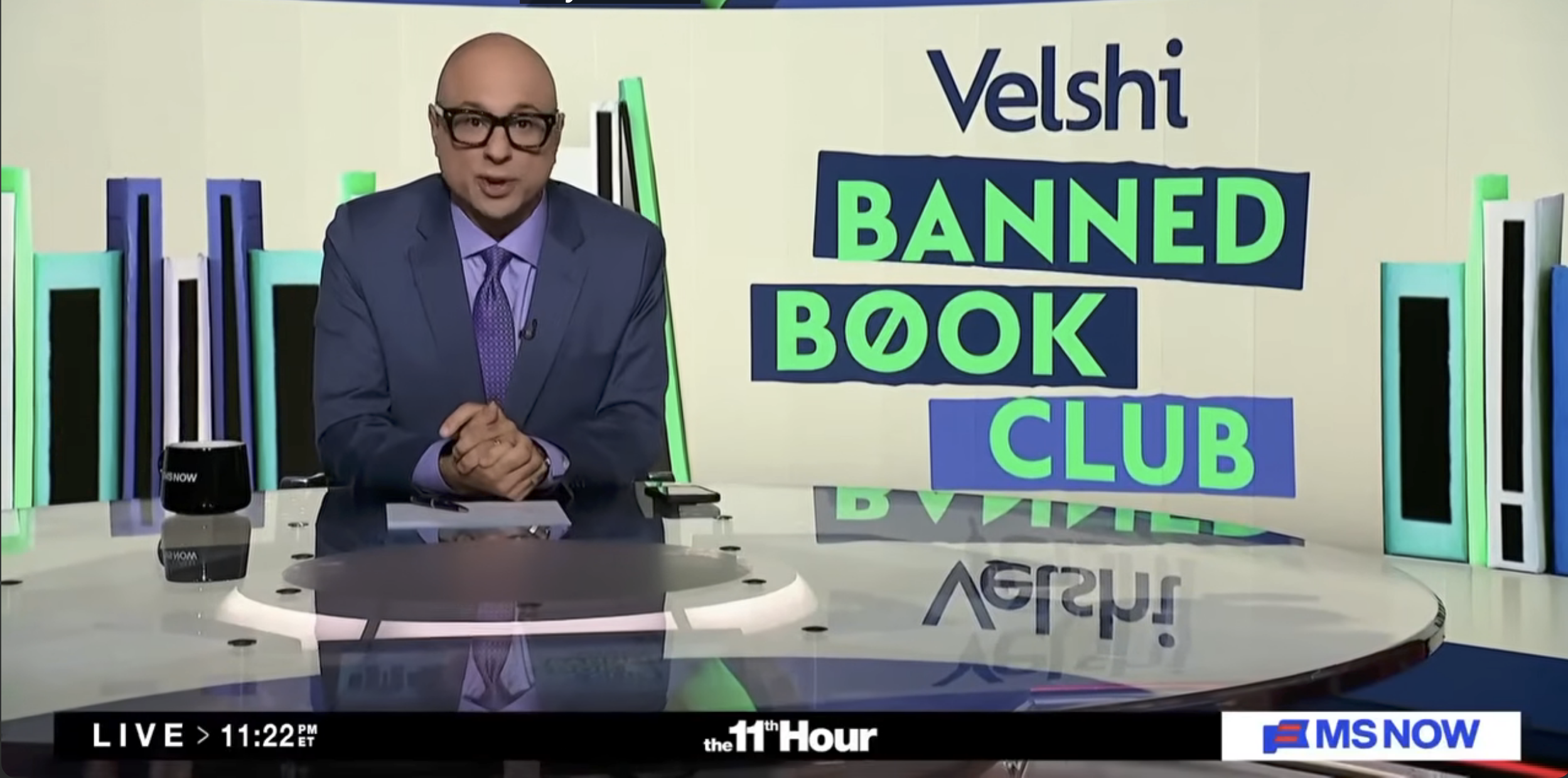
Since taking over MS NOW's The 11th Hour this June, Ali Velshi has built his show around a simple, recurring idea: the truth is always there to be found, and what separates good outcomes from bad ones is whether we choose to go looking for it. Three recent segments - on book banning, on Juneteenth, and on federal support for scientific research - make that same case from three different angles. Taken together, they argue that understanding history and following evidence keep us from repeating our worst mistakes, and what make people's lives measurably better.
Banning Books and Understanding
Velshi has spent years hosting the Velshi Banned Book Club, a project he started after noticing a wave of local efforts to pull books from school and library shelves, launched in May 2022 with discussion with author Margaret Atwood about her 1985 novel The Handmaid’s Tale.
[As an aside, we’ve experienced the dark cloud of book banning locally in Thousand Oaks, California - something I discussed in my book Local Democracy in America][4]
What looked like scattered, under-covered local disputes turned out to be the leading edge of a coordinated national campaign that has only grown since. The throughline in Velshi's coverage is that banning a book is rarely about the book itself - it's an attempt to stop people, especially young people, from encountering ideas, histories, and experiences that someone else has decided they shouldn't know. Reading, in his framing, is an act of resistance precisely because knowledge is the thing being targeted.
Juneteenth and The Refusal to Retreat into Myth
Velshi's Juneteenth broadcast - in just his first week behind the new desk - discussed the dedication of the Obama Presidential Center in Chicago, noting that Obama grounded his remarks not in his own biography but in shared national artifacts on display there - a founding-era print of the Declaration of Independence, a pen and inkstand used by Frederick Douglass, Lincoln's Bible, a pamphlet by Ida B. Wells - and his observation that freedom is sometimes delayed and dreams deferred, a line that lands differently on a holiday marking word of freedom arriving two and a half years late. [5]
Velshi then gave most of the segment to historians Eddie Glaude Jr. (Princeton, author of the new America, USA: How Race Shadows the Nation's Anniversaries [6]) and Imani Perry (Harvard, author of Black in Blues [7]). Both argued that Juneteenth only becomes fully meaningful if treated as what Glaude called a "portal" into where the country actually fell short, rather than folded into a comfortable myth of American exceptionalism. Perry drew a direct line between today's disregard for court rulings and separation of powers and the lawlessness of 19th-century secessionists, warning that the country is operating in a "moment of deep anti-intellectualism" - an active attack on knowledge and expertise - that makes it all the more necessary, in her words, to "tell the story true." [8]
Lizards, Federal Grants, and The Next Miracle Drug
Another example came in a "Night Light" segment about scientific research. [9] In 1992, a VA endocrinologist named John Eng studied the saliva of the Gila monster, a desert lizard that eats only a few times a year yet keeps its blood sugar remarkably stable. Eng found a hormone that mimics one the human pancreas uses to manage insulin - research made possible by NIH funding. That discovery became the basis for every GLP-1 drug now in wide use, including Ozempic and Wegovy, medications that have reshaped treatment for diabetes and obesity.
Velshi's point was that this kind of breakthrough depends on unglamorous, sometimes slow-moving federal science funding - exactly what came under threat last year when DOGE moved to cut billions in NIH grants and lay off researchers. Congress and the courts blocked some of those cuts, but thousands of grants and early-career scientists were lost before that happened. Hundreds of NIH employees signed declarations objecting to the dismantling of their agency, some facing retaliation for doing so. Velshi's point: the next Ozempic is sitting in some uncelebrated lab right now, and whether it ever reaches a patient depends on choices being made about that funding today.
Honoring the Truth Seekers
A banned book is information someone decided you shouldn't have, and an erased history is the same problem at national scale. A defunded research grant is that same instinct applied to medicine - and it's the one place where the cost of not knowing is the most measurable, in lives and treatments delayed or lost.
Velshi's recurring argument - and one of which I agree - is that the search for truth is a precondition for making good decisions, whether that's deciding what our kids can read, what our country's history actually contains, or which lab gets funded long enough to find the next cure. Choosing not to know doesn't make problems go away; it just guarantees we'll meet them again without learning lessons that are right in front of us to be learned.
One of the tenets I believe in is honoring the truth seekers [10] - the people who do the work of finding out what's actually true and saying so, even when it would be easier not to. Across these three segments, Velshi is doing exactly that. He didn't have to spend a Juneteenth broadcast on a 19th-century poem and the longer history of attempts to erase Black Americans from the national story. He didn't have to give airtime to a lizard and a federal grant program most viewers will never directly interact with. He chose those stories because they illustrate that the habit of looking for the truth, book by book, history by history, is what protects us from repeating our worst mistakes.
These choices are themselves a form of truth-seeking. For that, Ali Velshi belongs on the list of people worth honoring under that tenet.
Notes and Sources
[1] “Every single banned book from Ali Velshi’s ‘Banned Book Club’,” MS NOW, Jun 10, 2024, retrieved Jun 20, 2026, https://www.ms.now/ali-velshi/read-every-banned-book-ali-velshi-banned-book-club-rcna156215
[2] “Velshi Banned Book Club,” MS NOW, Apple Podcasts, retrieved June 20, 2026, https://podcasts.apple.com/us/podcast/velshi-banned-book-club/id1702778436
[3] “Velshi Banned Book Club,” MS NOW, Spotify, retrieved June 20, 2026, https://open.spotify.com/show/5aNexow0eunIj4QhXnM2QA
[4] Mic Farris, Local Democracy in America, Amazon Kindle Direct Publishing, 2025.
[5] “‘Underbelly of this fragile experiment’: Commemorating Juneteenth as Trump attacks civil rights,” The 11th Hour with Ali Velshi, MS NOW, YouTube, June 19, 2026, https://www.youtube.com/watch?v=10p4USOAsO4&list=PLDIVi-vBsOEyKAKu4Mln1dSoBgQqOJUNz&index=2
[6] Eddie S. Glaude, Jr., America, U.S.A.: How Race Shadows the Nation's Anniversaries, Crown, New York, 2026, https://www.amazon.com/dp/0593239806
[7] Imani Perry, Black in Blues: How a Color Tells the Story of My People, Ecco, New York, 2026, https://www.amazon.com/Black-Blues-Color-Tells-People/dp/0062977415
[8] “‘Underbelly of this fragile experiment’: Commemorating Juneteenth as Trump attacks civil rights,” The 11th Hour with Ali Velshi, June 19, 2026.
[9] “The 11th Hour with Ali Velshi,” MS NOW, Internet Archive, June 19, 2026, retrieved June 20, 2026, https://archive.org/details/MSNOW_20260619_030000_The_11th_Hour_With_Ali_Velshi/start/3480/end/3540
[10] Mic Farris, “Honor the Truth Seekers,” Decisions, February 2, 2025, https://www.micfarris.com/articles/honor-the-truth-seekers
Decisions with Mic Farris
Seek Truth. Honor Differences.