The Rebuke is the bookend to the Trump Era, but the political transformation isn’t complete. Here’s what I think is left.
If you’d like these posts delivered directly to you, subscribe to the Decisions newsletter now!

So, the Blue Wave of 2026 – and what I’ve been describing lately as The Rebuke – is a week old. We’ve discussed the results and the near-term impact. [1][2]
I did mention that I would need to write out my thoughts in three separate posts, so here are links to the previous ones to get the full picture:
The results – the full breadth and depth of The Rebuke (my first post)
The impact and fallout of The Rebuke and what’s possible over the next 1-2 years (my previous post)
The future to come – what I think will happen beyond the near-term (this post)
So, let’s talk about the future.
Below I’ve reposted a Twitter thread I wrote from 2019 (seven years ago) – this five-act arc came after Democrats pulled off the first Blue Wave in 2018, taking over Congress and providing a check to President Donald Trump in his first term.
You'll note the "xx/" marker because way-back-then Twitter had a much lower 280-character count (and this was up from 140…), so you needed to generate a real thread for longer posts.
But this thread didn't anticipate:
COVID
January 6
COVID-related inflation and adherence to Trump and Trumpism by the majority of remaining Republicans that led to Trump’s re-election in 2024
(I mean… who could truly anticipate these?...)
These unanticipated events don’t really change the arc but instead extended the timeline I laid out by about 6 years. This means that the Blue Wave of 2026 is really where Act III starts (instead of what was hoped for in 2020).
From what I see, we will return to a functioning two-party political system, because I do believe American genuinely care about self-governance. But it will take some time to go through this full political realignment.
In The Rebuke, voters repudiated Trump and Trumpism - as a "governing" philosophy - but the GOP has now been reduced to its radioactive core (see Act IV).
Conversely, the Democratic Party, with roots in the Democratic-Republican Party formed by Thomas Jefferson and James Madison in 1792, was founded in its modern form in 1828, making it the world’s oldest active political party. [3]
And The Rebuke demonstrates its resilience.
Going forward, I believe the Democratic Party will remain strong and move the country forward, but any political system that captures the legitimate differences of opinion among people needs a counterbalance – a political check – on any excesses of one political party.
The real outstanding question, though, is this: Will the Republican Party be that party, or will a new political party be the restart?
Will the GOP as a vehicle be what reforms itself to serve as a viable second party, or will it be pushed to the side and restarted as a conservative-minded party to complete the political realignment through this period?
In the thread below, I argue that a new party will be how this all plays out. I had thought that seven years ago, and I still think this is the most likely scenario.
Reasonable people with more conservative governing beliefs will not try to take the GOP back. They will instead say that the best way to defeat the Trumpists left in the GOP is to create a new vehicle where they control the doors of who they let in.
And the fundamental litmus test for this will be whether one answers the question truthfully…
Did Trump win the 2020 election?
Stuart Stevens, former advisor to Mitt Romney’s 2012 presidential campaign and Senior Advisor to the Lincoln Project, spoke about the future of the Republican Party: [4]
“You didn’t have to go along with Trump… There’s still free will in this country. None of these Republican officeholders had to do this… A party without room for a [Liz] Cheney? How do you build a party like that?
As long as you have a test – a purity test – that you have to assert what any fifth-grader knows not to be true – that Donald Trump won the 2020 election – who’s going to be attracted to that party?
It’s like trying to build NASA, but you have to [repudiate] Copernicus. You’re not going to get to the Moon – I’ll tell you that…
I don’t know when that’s going to happen – it’s not going to happen in ’28, maybe in ’32.”
That’s what I believe will be the founding seed of a second American political party – a party grounded in the truth that our elections are fair, Joe Biden won the 2020 election, and Donald Trump lost.
The reason it has taken so long is not that there was any truth to the Big Lie; it was the gravitational pull to Trump as a source of political power.
But that is over now. The gravity is gone, and the truth is now allowed to be recognized without the perception of consequences.
So, a second party in our two-party system will either be a truly reformed Republican Party or a new Conservative Party.
But a Republican Party that continues to promote the Big Lie will die out.
How to interpret the thread below
The thread was written in 2019, so some of the facts from back then may be long forgotten in our memory, and some of the dates of events were shifted further into the future. A political realignment that I thought might take 10-12 years looks like it could be twice that.
But I always believed there would eventually be a GOP wipeout – the signs were always present. I just thought it might happen in 2020 instead of 2026.
So, any date from Act III on should be extended by another 6-8 years. I didn’t try to modify the details or dates - instead keeping the major events of the arc for what we could expect over the next decade. (Although, I did address some typos and grammar from the original Twitter thread.)
And given these extensions in the timeline, I can see the realignment stabilizing in 2036 (vs the original thought of 2028).
Plus, at the time, there was a prospect of an independent presidential candidate in 2020 (Howard Schultz). While that didn’t materialize, the effects of a third presidential candidate play into what a new conservative-minded party would encounter.
But that said, I think the American political realignment is still happening, and this arc is the one that still seems the most reasonable – both seven years ago and going forward.
THREAD: 2020 is an important election cycle, possibly the most important of our time. However, in context, we may be only a third of the way through the realignment of American politics. The following is a play in five acts for this realignment. 1/
Before we start, this is a hypothesis, which, as I know, can explode into many pieces as reality plays out. I am a student, though not a scholar, of American history, love my country, and am enamored with her politics. 2/
That said, it's (I think...) a hopeful view for managing through the American political and governing crisis at hand. Our politics will unfold in acts, but the transition will be seen as the acts are revealed. 3/
By the way, I feel that Trump is a unique threat to our form of government, and I've always felt (from Dec 2016 onward) that L'Affaire Russe would be the Achilles’ heel for Donald Trump, and I still do. 4/
I believe his business activity is hopelessly intertwined with the connections between his presidential campaign and Russian election influence. Not sure what will eventually do Trump in; L'Affaire Russe will be the primary historical nexus to bring all of this together. 5/
I thought that we would get to the heart of the matter by 2018 and that Republicans would see the electoral handwriting on the wall before the Nov 2018 elections, forcing him to vacate the Oval Office; we now know that this was optimistic. 6/
Given the Blue Wave of 2018, though the details may differ, I think the five-act play below lays out the broad strokes of what can be the path forward for American democracy and its political realignment. Let’s begin… 7/
PROLOGUE (2008-2014): Through various election cycles, the Republican Party becomes increasingly controlled by extreme elements of their coalition. In 2008, the GOP selects Sarah Palin, then Governor of Alaska, but highlighting style over substance. 8/
With the Great Recession, the high risk decision of adding Palin to the presidential ticket sets the stage for the downfall of the party as a whole. 9/
Following the election of Barack Obama, the Tea Party movement forms, energizing the more radical elements of the Republican Party. Tea Party members seem to oppose both Democrats and the current Republican leadership. 10/
An October 2010 Washington Post canvass of local Tea Party organizers found 87% saying "dissatisfaction with mainstream Republican Party leaders", 92% are opposed to "Obama/the Democratic Party's policies", and 92% have "mistrust of government overall". 11/ [5][6]
The 2010 election, with strong support from the Tea Party, resulted in significant Republican gains. The GOP won the popular vote by 6.8% and yielded a net change in the House of 63 seats, allowing them to take over the lower chamber of Congress. 12/ [7]
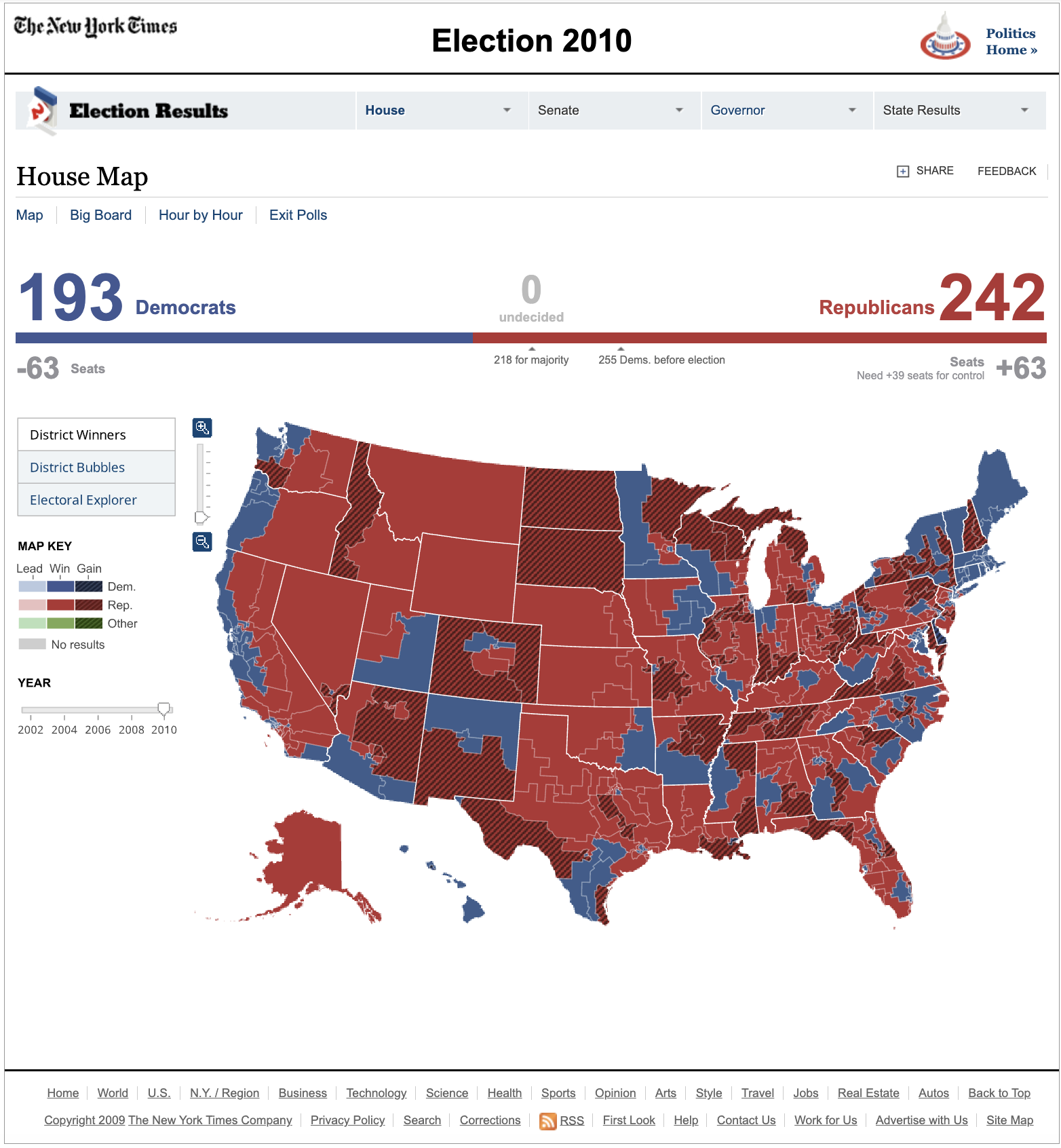
They also gained 6 Senate seats and 6 add'l governorships. President Obama described the election results as a "shellacking" for the Democratic Party. 13/ [8]
Birtherism, the conspiracy theory purporting that Barack Obama is ineligible to be President because he wasn't born in the US, started in 2008, but took hold with fervor when Donald Trump used the issue to gain attention for his own presidential aspirations in 2010. 14/
With a strong 2010 win came Republican efforts to solidify electoral gains. Redrawing district boundaries through gerrymandering allowed Republicans to gain and keep disproportionately large majorities in state legislatures and in Congress. 15/
Obama won re-election in 2012, and after losing the Presidency and some seats in Congress, the GOP examines its position from the 2012 election and conducts what they call an "autopsy". You can read it here: 16/ [9]
The Atlantic called the 2012 GOP Autopsy report "an astonishingly frank document that calls for major changes in how the party addresses minorities, women, and its own campaign processes." 17/ [10]
In one passage, the autopsy report notes: "If Hispanic Americans perceive that a GOP nominee or candidate does not want them in the United States (i.e. self-deportation), they will not pay attention to our next sentence." 18/ [11]
Does the GOP follow the advice from their own autopsy report, or does it double down on power-holding tactics, such as voter suppression, gerrymandering… --> 19/
…big and dark money, tax cuts policies that benefit wealthy donors, obstruction (blocking the Merrick Garland nomination to the US Supreme Court), marginalizing and scapegoating ethnic minorities? Well, enter Act I... 20/
ACT I (2016): While Trump doesn't seek the White House in 2012, he does in 2016. During his 2015 announcement speech, he scapegoats people of color, targeting Hispanics first. 21/
Trump in 2015: “When Mexico sends its people, they’re not sending their best... They’re bringing drugs. They’re bringing crime. They’re rapists. And some, I assume, are good people.” 22/ [12]
GOP ignored their own 2012 autopsy and doubled down on the tactics of party cohesion versus a compelling governing message. The weakness of the presidential field allows Trump to win the nomination. This gives us the first overt signs that the party has been hollowed out... 23/
Other significant factors in the GOP’s decline as a party is their lack of principles during the election… 24/
From an NPR report, Joe Biden stated that Mitch McConnell, GOP Senate Majority Leader, "refused to sign a bipartisan statement condemning the Kremlin's role" in 2016, which was why President Obama didn't speak publicly on Russian interference during the election. 25/ [13]
As with any compelling drama, Act I introduces the characters (Trump, GOP, Democratic Party, Russia) and presents the inciting incident. In this case, the Inciting Incident is the election of Donald J Trump to the US Presidency. 26/ [14]
ACT II (2018): Even though the Republican Party now has control of the House, the Senate, and the Presidency, they have no plan for governing. The quintessential example of this is the effort to "repeal and replace" the Affordable Care Act, or Obamacare. 27/
After the ACA was enacted in 2010, Republicans used every subsequent Congressional session to attempt its repeal, knowing that the ACA would not be undone, either because the Senate wouldn't take up the bill or due to a presidential veto. 28/
For example, in a February 2, 2016 vote, with a tally of 241–186, the GOP-controlled House attempted for the 63rd time to repeal the ACA, going back to January 2011. This was obviously very important to them, or a low-risk way to gain political points. 29/ [15]
However, once the GOP obtained full control over Congress and the White House, they were exposed as having no plan to "repeal and replace" the ACA. 30/
From the Washington Post, "...the GOP failed dramatically in its efforts last year to roll back the ACA as its first big legislative delivery on the promise of single-party control of Washington from Congress to the White House." 31/ [16]
The GOP proved itself unable to govern once they had the ability to do so. Their political activities were merely designed to obstruct others, or to keep power at all costs. This came from the consistency of obstructing any efforts to understand L'Affaire Russe. 32/
Devin Nunes, chair of the House Intelligence Committee, ran interference for the White House as concerned Congressional leaders attempted to get answers. Remember his "midnight run", trying to discredit the intelligence community? 33/ [17]
Additionally, when the President acted in ways so counter to American interests, Republicans stayed quiet, feigned ignorance, or attacked those who dared to hold the President accountable. 34/
Examples include efforts to lift sanctions on Russia, even though Russia attacked our elections, or stating that there was "blame on both sides" for the deadly, white supremacist demonstrations in Charlottesville, VA. 35/ [18]
The election of Trump led to a significant awakening among the public, starting with the Women's March on Washington, where between 3.2 million and 5.2 million people participated across the country. 36/ [19]
This led to the building of the Resistance, the Indivisible movement, and post-2016 election wins for Democrats, including the Alabama Senate seat, and the 2018 Blue Wave election, winning 40 seats and taking back the House of Representatives. 37/ [20]
Even with these Democratic electoral victories, one example of how strong the GOP’s hold on power is comes from the Wisconsin statehouse elections. 38/
From the Journal Sentinel: [21]
GOP Gov. Scott Walker lost his bid for re-election by roughly 1 percentage point Nov. 6 to Democrat Tony Evers.
Yet Walker carried 63 of the state’s 99 state Assembly districts. 39/
In other words, in WI, Democrats won statewide, but Republicans won 63 of 99 seats in the Assembly due to the way the district boundaries were drawn. 40/
The efforts by Americans to wrest undeserved power from the Republican Party will not end with one election... thus, we conclude Act II. 41/
INTERMISSION: Is the answer an independent presidential candidate? Let's take a look... 42/
Where there is political opportunity, a potential Howard Schultz candidacy or something like it is inevitable, but in my opinion, it's two years too early. 43/ [22]
(*Spoiler Alert*) There will be an effort to build a new party with new candidacies and this will happen in 2021 (see Act III), in preparation for 2022 and 2024, to snuff out the embers of the 2020 GOP flameout. 44/
I believe the Coalition of All Democratic Forces (as @benjaminwittes likes to call it), an effort to preserve the nation’s democratic institutions, will stay together, but in political form for only one more election cycle, turning out Trump and his hardened black core of a GOP base. 45/ [23]
For the sake of argument, and to present context, what would happen if an independent candidate for President entered the 2020 race? 46/
For someone to win in a three-way presidential race, you need to win a majority of electoral votes; this is a constitutional requirement. That means winning states in multiple three-way races. 47/ [24]
What happens in the electoral college? In a three-way race, there are four potential outcomes: The Democrat gets a majority of EVs, the Republican does, the Independent does, or no one gets a majority. 48/
The likelihood that an independent would win outright in 2020 is low (if not very, very, very low). But, let's even look at what would happen if no one gets a majority in the Electoral College. 49/
The Constitution states, under the 12th Amendment, that the House of Representatives picks the President, where each state gets one vote. If we used the House breakdown as it is in 2019, who would win? 50/ [25]
Using today’s state delegation breakdown, Republicans would win 26 states, Democrats 23, and there would be one tie. One can assume that the GOP would win the Presidency in this scenario. Plus, if Republicans hold the Senate, they would also pick the VP. 51/
One note: I don't really know how the District of Columbia is represented if the House needs to elect the President. DC has 3 electoral votes, but they have no voting state delegation in the House. Based on a NYT analysis from 1992, it appears they would have no role: 52/ [26]
Could a strong Independent get votes in the House? Well, it’s not impossible, but highly doubtful that the Indy could win. 53/
In 1992, Ross Perot reached 39% in the polls, compared with 31% for Bush and 25% for Clinton. There was serious discussion at the time about whether House members would stick with their party nominee if the race were thrown to the House: 54/ [27]
If there is a competitive three-way race, there are 3 outcomes for the Indy candidate: (1) win outright, (2) take some EVs to deny an outright winner, or (3) win no electoral votes. 55/
An outright Indy win is very, very, very unlikely, which means that the likely outcome would be a Trump re-election. This implies that, for the Indy candidate, it’s more important for the Democrats to lose than the GOP (I disagree…). 56/
All that said, the recent poll on Schultz's initial reception may stave off any independent candidacy in 2020. 57/ [28]
In a certainly an unintended twist, one could say that he's given his (political) life for his country. 57a/ [29]
By the way, even Ross Perot, who started the Reform Party coming out from his 1992 campaign, knew that America is not built for more than two parties.
Note the discussion between Perot and Larry King, when he announced the new political party in 1995 --> 58/ [30]
LARRY KING: "Can a three party system work?"
ROSS PEROT: "There won't be a three party system. One of these parties is going to disappear. One of those special interest parties will have a meltdown."
Keep this in mind in our later acts. Now, back to our play... 59/ [31]
ACT III (2020): Recognizing that the Blue Wave only prevented slipping into the authoritarian abyss, more focus is placed on defeating the GOP in the 2020 election. Opposition continues to solidify behind Democrats, leading to a GOP wipeout in 2020. 60/
With a mano-a-mano political battle, Democrats take the White House and both houses of Congress. They secure more statehouses, and now, just as the GOP found themselves in 2010, Democrats are in control of major restructuring by redistricting, undoing GOP gerrymandering. 61/
There is vigorous re-energizing of the Democratic party - a wealth of fresh candidates, diversity of views, opinions, and representation, and a clarity of the constituencies served by the two parties (diverse new America vs white, old America patriarchy). 62/ [32]
Strikingly, there is a continuation of strong party discipline of the Democratic campaigns and Congressional activity (e.g., working together vs infighting and lack of cohesion). 63/ [33]
With a rapid decline from its peak power in 2016, a 2020 GOP wipeout leads conservatives and others looking for a counterbalance to the much stronger Democratic Party to look for other options... 64/
ACT IV (2022): Starting in 2021, conservatives see GOP as an unrecoverable vessel for future success - the Republican brand has been boiled down to a radioactive core, and the criminality and complicity among its leadership leads supporters to look elsewhere. But where? 65/
To rebalance the two-party system, there are two options: (1) fight for control over the GOP itself, or (2) "expel" the influence of complicity and racism from the party base and form a new party, letting the radical elements have complete control over a dying GOP. 66/
America is a two-party country - the requirement to win a majority of electoral votes to gain the Presidency creates an environment for two strong parties. At times though, one of the parties needs replacing, and in 2021, that will become the arc of American politics. 67/
Now that the GOP has been defeated, conservatives and NeverTrumpers coalesce to form a new party to displace the GOP and provide a legitimate counterbalance to Democratic party going forward. 68/
Building a party from scratch is not easy – there are 50 state requirements for how parties form and getting on the ballot. This is a long-term and complex effort, and the new "conservative" party supporters, in recognizing this, are up for the challenge. 69/ [34]
The new "conservative" party, expelling its radical positions on race and other extreme views, wins some seats in Congress and statehouses (in states where party access is easier and not tied to presidential finish). 70/
Governor candidates run in other states to guarantee ballot access for 2024 presidential race. Some elected GOPers switch parties, and even some more conservative Democrats. 71/
ACT V (2024): In their first presidential election, the new party is on the ballot in all 50 states plus DC. The Democrat, first winning in 2020, wins re-election, but the conservative party wins electoral votes from a few states, including the South, finishing second. 72/
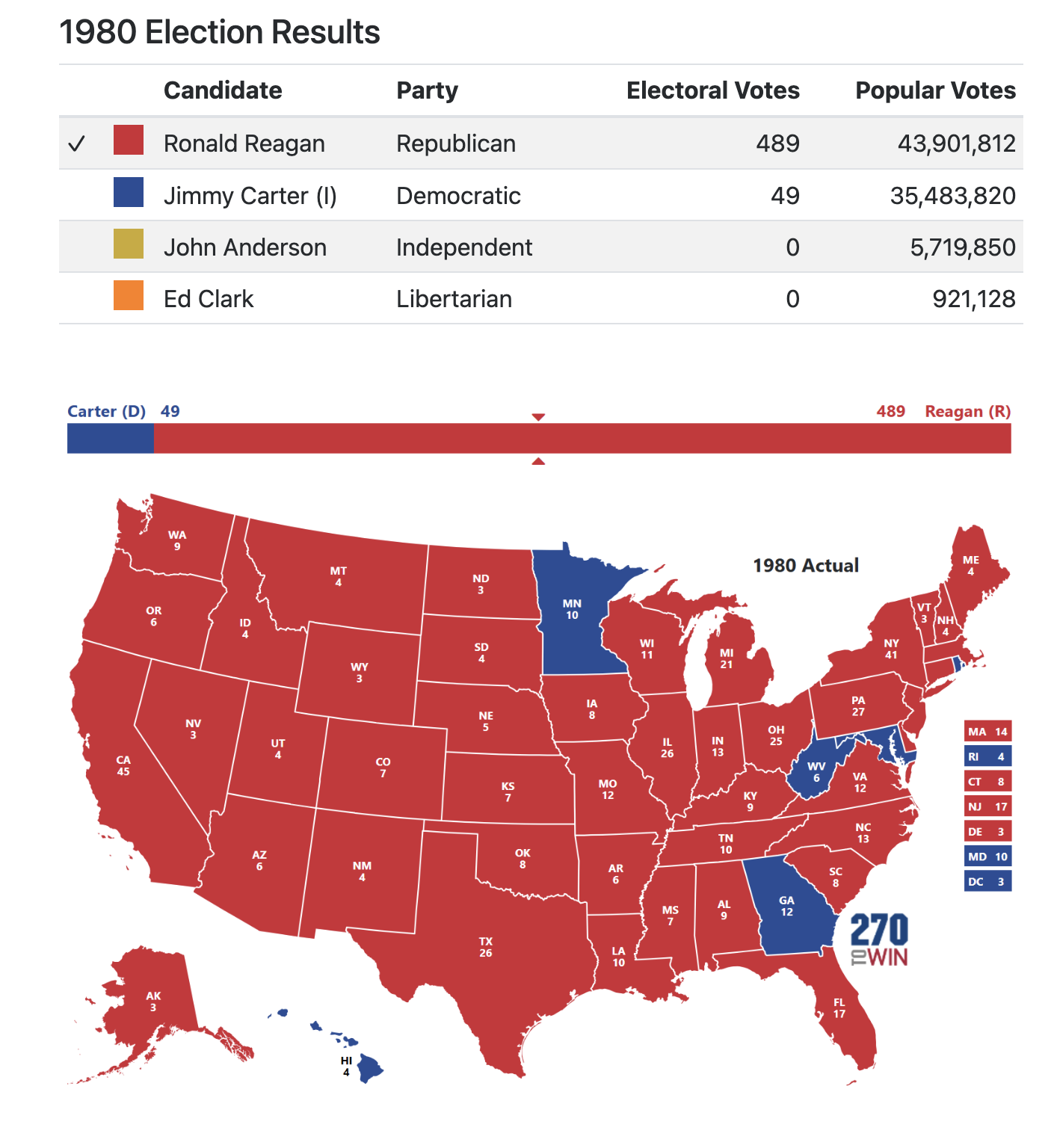
More politicians switch parties. The electoral college win for the Democrats will be large (400+ EVs, possibly a 1980 Reagan-like victory), but the political realignment will have turned the corner, and the Republican Party will become a historical footnote. 73/ [35]
POSTSCRIPT (2026 and beyond): With the realignment complete, the new conservative party displaces GOP and electoral victories grow. The two-term Democratic president is term-limited, and the 2028 election will become a key contest of a newly constituted opposition party. 74/
As a result of this political realignment, American governing institutions will be strengthened, and a stronger two-party system will emerge. Each party will hold common American values with the other and offer differing views on how to govern. 75/
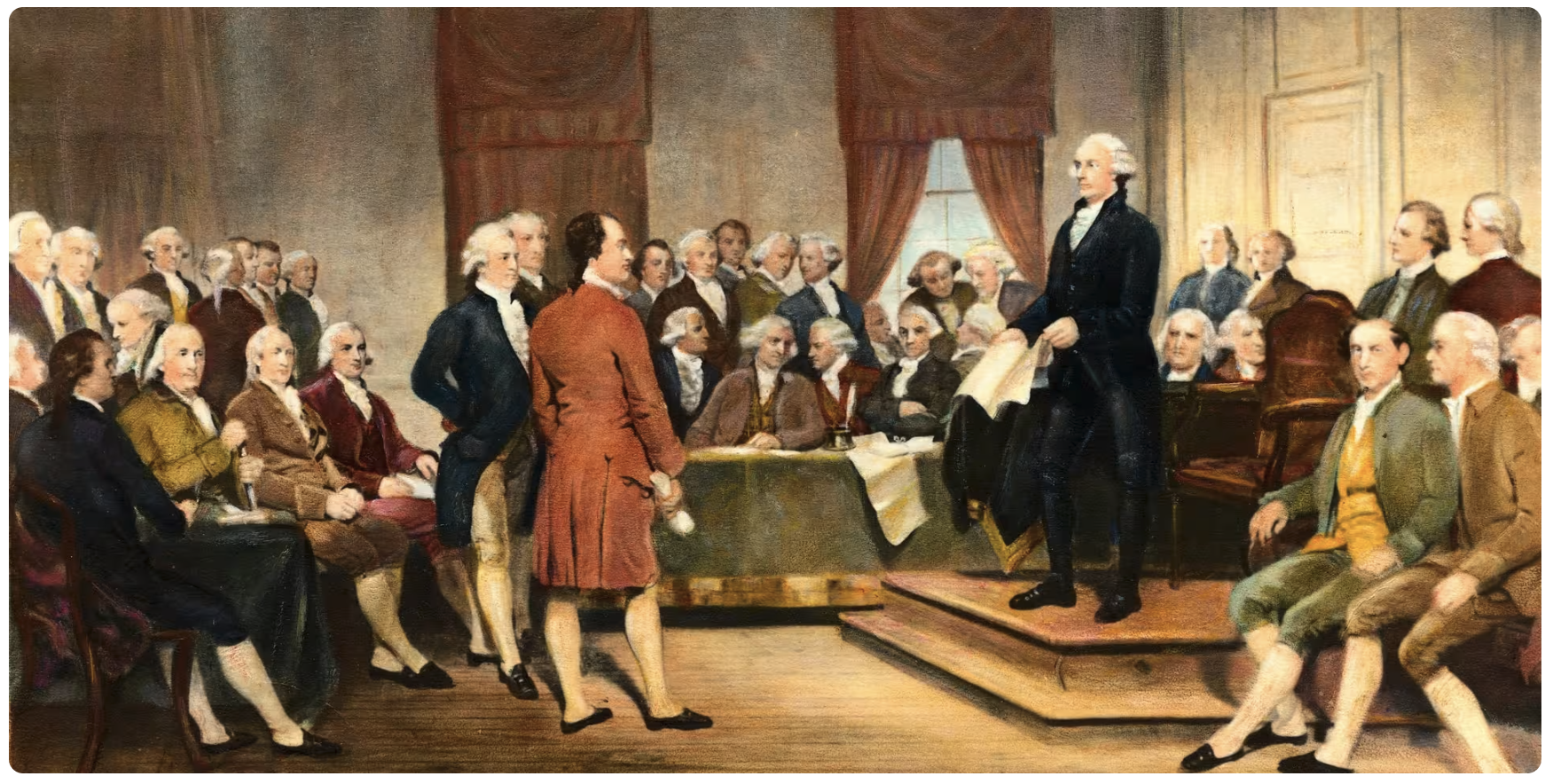
In the end, a renaissance of American self-governance and the resiliency of our Constitution will be appreciated.
And scene... 76/END
Notes and Sources
[1] Mic Farris, “The Clearest of Decisions: The Rebuke,” Decisions, November 7, 2026, https://www.micfarris.com/articles/the-clearest-of-decisions
[2] Mic Farris, “The Clearest of Decisions: The Impact,” Decisions, November 9, 2026, https://www.micfarris.com/articles/the-clearest-of-decisions-the-impact
[3] “Democratic Party (United States),” Wikipedia, retrieved November 10, 2026, https://en.wikipedia.org/wiki/Democratic_Party_(United_States)
[4] Katy Tur, “Katy: GOP choosing to ignore the issue of ‘corruption’ led them to massive loss,” The Moment with Katy Tur, MS NOW, November 5, 2026, https://www.ms.now/katy-tur/watch/katy-gop-choosing-to-ignore-the-issue-of-corruption-led-them-to-massive-loss-2519801411555
[5] “An up-close look at the tea party and its role in the midterm elections,” Washington Post, October 24, 2010, https://www.washingtonpost.com/wp-srv/special/politics/tea-party-canvass/
[6] Amy Gardner, “Gauging the scope of the tea party movement in America,” Washington Post, October 24, 2010, https://www.washingtonpost.com/wp-dyn/content/article/2010/10/23/AR2010102304000.html
[7] “Election 2010,” New York Times, retrieved November 10, 2026,
https://archive.nytimes.com/www.nytimes.com/elections/2010/results/house.html
[8] “Election 2010,” New York Times, retrieved November 10, 2026,
https://archive.nytimes.com/www.nytimes.com/elections/2010/results/senate.html
[9] “Growth & Opportunity Project,” Republican National Committee, March 18, 2013, https://www.wsj.com/public/resources/documents/RNCreport03182013.pdf
[10] Garance Franke-Ruta, “What You Need to Read in the RNC Election-Autopsy Report,” The Atlantic, March 18, 2013,
https://www.theatlantic.com/politics/archive/2013/03/what-you-need-to-read-in-the-rnc-election-autopsy-report/274112/
[11] Ibid.
[12] “Donald Trump Presidential Campaign Announcement Full Speech (C-SPAN),” C-SPAN, YouTube video, June 16, 2015, https://www.youtube.com/watch?v=apjNfkysjbM
[13] Scott Neuman, “Biden: McConnell Refused To Sign Bipartisan Statement On Russian Interference,” NPR, January 24, 2018, https://www.npr.org/sections/thetwo-way/2018/01/24/580171396/biden-mcconnell-refused-to-sign-bipartisan-statement-on-russian-interference
[14] “Trump’s First Day,” Time Magazine, January 21, 2017, https://archive.ph/9Ozik
[15] “House’s 63rd Attempt to Dismantle Obamacare Fails Also,” Newsweek, February 2, 2016, https://www.newsweek.com/houses-63rd-attempt-dismantle-obamacare-fails-also-422418
[16] Paige Winfield Cunningham, “Republicans lose their favorite campaign message: Repealing Obamacare,” Washington Post, April 14, 2018, https://www.washingtonpost.com/politics/republicans-lost-their-favorite-campaign-message-repealing-obamacare/2018/04/14/c81f3dcc-3dbe-11e8-974f-aacd97698cef_story.html
[17] Tim Mak, “Devin Nunes Vanished the Night Before He Made Trump Surveillance Claims,” The Daily Beast, March 24, 2017, https://www.thedailybeast.com/devin-nunes-vanished-the-night-before-he-made-trump-surveillance-claims
[18] Dan Merica, “Trump says both sides to blame amid Charlottesville backlash,” CNN, August 15, 2017, https://www.cnn.com/2017/08/15/politics/trump-charlottesville-delay/index.html
[19] Anemona Hartocollis and Yamiche Alcindor, “Women’s March Highlights as Huge Crowds Protest Trump: ‘We’re Not Going Away’,” New York Times, January 21, 2017, https://www.nytimes.com/2017/01/21/us/womens-march.html
[20] Matthew Yglesias, “Democrats’ blue wave was much larger than early takes suggested,” Vox, November 13, 2018, https://www.vox.com/policy-and-politics/2018/11/13/18082490/blue-wave
[21] Craig Gilbert, “New election data highlights the ongoing impact of 2011 GOP redistricting in Wisconsin,” Milwaukee Journal Sentinel, December 6, 2018, https://www.jsonline.com/story/news/blogs/wisconsin-voter/2018/12/06/wisconsin-gerrymandering-data-shows-stark-impact-redistricting/2219092002/
[22] Edward-Isaac Dovere, “Ex–Starbucks CEO Could Get Trump Reelected,” The Atlantic, January 26, 2019, https://www.theatlantic.com/politics/archive/2019/01/howard-schultzs-independent-run-could-help-trump/581374/
[23] Benjamin Wittes, “A Coalition of All Democratic Forces, Part I: A Political Focus on What's Truly Important,” Lawfare, October 17, 2016, https://www.lawfareblog.com/coalition-all-democratic-forces-part-i-political-focus-whats-truly-important
[24] “United States Electoral College,” Wikipedia, retrieved November 10, 2026, https://en.wikipedia.org/wiki/United_States_Electoral_College
[25] “12th Amendment: Election of President and Vice President,” National Constitution Center, retrieved November 10, 2026, https://constitutioncenter.org/interactive-constitution/amendments/amendment-xii
[26] Martin Tolchin, “THE 1992 CAMPAIGN: The Constitution; And if Perot Produces a Deadlock? The House Will Decide,” New York Times, May 10, 1992, https://www.nytimes.com/1992/05/10/us/1992-campaign-constitution-if-perot-produces-deadlock-house-will-decide.html
[27] Jack W. Germond and Jules Witcover, “Perot Candidacy Could Force House to Elect President ON POLITICS,” Baltimore Sun, May 26, 1992, https://www.baltimoresun.com/1992/05/26/perot-candidacy-could-force-house-to-elect-president-on-politics/
[28] “Polling on Howard Schultz for President,” Change Research, Medium post, February 1, 2019, https://medium.com/@ChngRsrch/presidential-polling-on-howard-schultz-for-president-db970ad2b42d
[29] “Nathan Hale,” Wikipedia, retrieved November 10, 2026, https://en.wikipedia.org/wiki/Nathan_Hale
[30] Galen Druke, “Long Before Trump, There Was Ross Perot,” FiveThirtyEight, October 24, 2016, https://archive.ph/CZ2NS
[31] John B. Judis, “The Third Rail,” The New Republic, May 19, 1996, https://newrepublic.com/article/103458/third-party-populism-ross-perot-charles-de-gaulle
[32] Elise Viebeck, “Diversity on stark display as House’s incoming freshmen gather in Washington,” Washington Post, November 13, 2018, https://www.washingtonpost.com/powerpost/diversity-on-stark-display-as-houses-incoming-freshmen-gather-in-washington/2018/11/13/87ef9a5c-e783-11e8-bbdb-72fdbf9d4fed_story.html
[33] Christian Fong, “How Nancy Pelosi overcame her opposition and became House speaker. Again.,” Washington Post, January 4, 2019, https://www.washingtonpost.com/news/monkey-cage/wp/2019/01/04/this-explains-why-nancy-pelosi-became-house-speaker-again-despite-opposition/
[34] ”The Worst Ballot Access Laws in the United States,” FairVote, January 13, 2015, https://www.fairvote.org/the-worst-ballot-access-laws-in-the-united-states
[35] “1980 Presidential Election,” 270toWin, retrieved November 10, 2026, https://www.270towin.com/1980_Election/
Decisions with Mic Farris
Seek Truth. Honor Differences.