The Rebuke was both broad and deep, which will have significant impacts over the next few years on our self-governance.
If you’d like these posts delivered directly to you, subscribe to the Decisions newsletter now!

Last week’s midterm elections – just wow!
It will eventually have a name associated with it, but for now, I’m going to call it The Rebuke.
I wrote about how elections are the ultimate check and balance in our self-governance, [1] and it’s been a wonderful experience to see America use that device to make the clearest of decisions.
The importance of elections is a common theme, on which I’ve written before – here, [2] here, [3] and here [4] – plus my book, Local Democracy in America, shows how this plays itself out at the local level. [5]
In discussing The Rebuke, I mentioned that I would need to write out my thoughts in three separate posts:
The results – the full breadth and depth of The Rebuke (my previous post)
The impact and fallout of The Rebuke and what’s possible over the next 1-2 years (this post)
The future to come – what I think will happen beyond the near-term
So, let’s talk about the impact.
Many times, elections are just slight adjustments in direction. The nature of how a city, state, or country is governed won’t change dramatically – generally going in the same direction, but moving left or right on its journey forward.
This election was not a minor course correction; it feels more like a U-turn. This is because, over the last ten years of The Trump Era, the direction of the country has gone very much in the wrong direction for most people.
Women lost reproductive health rights they had for over 50 years.
Black Americans lost voting rights protections they had for over 60 years.
It’s certainly not the first time Americans have lost rights that had been previously gained (e.g., federal civil rights protections were dismantled after Reconstruction, turning into Jim Crow segregation policies). [6] But these reversals are not what Americans were looking for.
And the country just seemed to get meaner – the loud voices of bullies got more influence, more power, and took a wrecking ball to the United States and its institutions (and in some cases, literally to the East Wing of the White House).
The attitude reminded me of dialogue from the 1987 classic movie Wall Street, where the young protégé Bud Fox asks why corporate raider Gordon Gekko must take over and dismantle Bluestar Airlines – the company his father has worked at for over two decades: [7][8]
Bud Fox: "Why do you need to wreck this company?"
Gordon Gekko: "Because it's WRECKABLE, all right?!"
There’s another illuminating line at the end of this dialogue that seems appropriate: [9]
Gordon Gekko: “It’s all about bucks, kid. The rest is conversation.”
Or even the original mantra of Facebook - “Move Fast and Break Things” – an approach about taking action quickly, though unconcerned or uncaring about the consequences to other people. [10]
For this election, while economic factors played a very large role in why voters voted the way they did this time, there were two big, seemingly esoteric factors that drove Americans to vote for Democrats – corruption and our democratic ideals.
In an exit voter poll, 91% of participants viewed the importance of government corruption as “a major factor” or “crucial” on their House vote… 89% viewed the importance of the cost of living in a similar way. [11]
When asked what the most important issue was for voters, two issues made up 72% of respondents: The economy (39%) and the state of democracy (33%). [12]
The impact is an increase in faith in ourselves and a greater trust that the will of voters can move the country in the direction that is actually intended.
The indication of where we’re heading? Let’s see what politicians are saying about it.
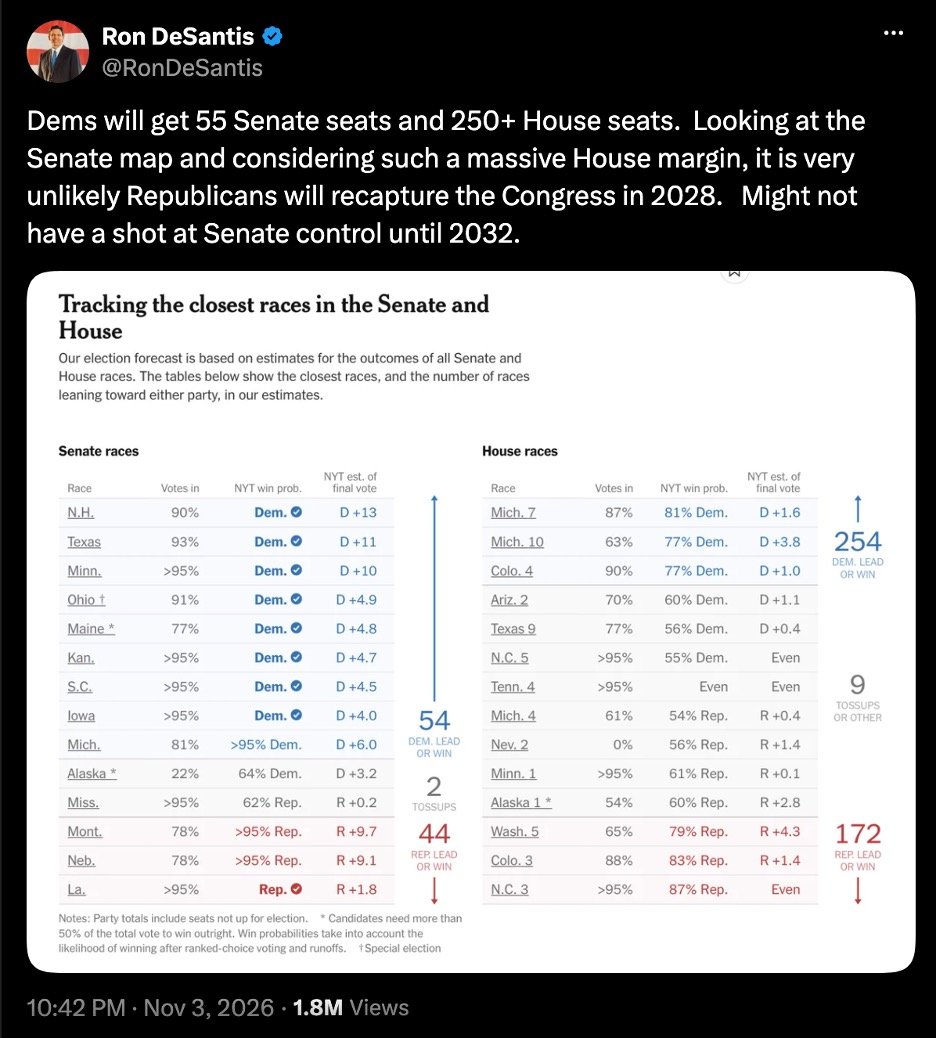
Outgoing Florida Governor Ron DeSantis warned that this drubbing could result in Democratic control of the U.S. Senate for at least six years: [13]
Dems will get 55 Senate seats and 250+ House seats. Looking at the Senate map and considering such a massive House margin, it is very unlikely Republicans will recapture the Congress in 2028. Might not have a shot at Senate control until 2032.
DeSantis even held a press conference to discuss the election results, describing it as a “meteor strike” and “close to an extinction level event for Republicans.” [14]
Last night we witnessed… to call it a wave I don't think would be fully accurate. It's the political equivalent of a meteor strike that went all around the United States. Blue states, red states, everything in between.
And the one state that was able to hold the line and withstand that is right here in the free state of Florida.
This is close to an extinction level event for Republicans in many parts of the country as we have seen probably in the last hundred years.
I think people can look at Florida and show you how you can deliver big results and how you can build a durable coalition because the reality is - you're probably not going to face an election climate this bad, perhaps in our lifetime.
We've shown we've shown how it can be done. I think it's going to take time to dig out of the hole that was there. That's just the reality of the situation.
[Now, DeSantis is likely trying to set himself up as the Republican Party standard-bearer for 2028 presidential election – telling his party that he may actually be the strongest candidate because the wave that took over the country didn’t affect Florida as much - so we should put these comments in context…]
This sentiment wasn’t just voiced from Florida leaders – Texas Republicans see the same signals. This is from Eric Benson of Texas Monthly, who described the state as having “skipped the purple phase all together, flipping from bright red to an unmistakable shade of blue” and quoted a former Texas House Speaker saying: “These are extinction-level numbers. This is a complete extinction-level election.”: [15]
Former Texas House Speaker Dade Phelan saw it coming—at least in part. Three weeks ago, when he and I sat down for an extended interview about the upcoming election, he told me the mood among Republicans was grim. “People are freaking out,” he said, exaggerating those last two words in his East Texas drawl for maximum effect. “You see it in their faces. There’s serious concern like I’ve never seen before.” Phelan could see the scenario in which a bad night for Republicans turned into a seismic shift in the state. If Democratic Senate candidate James Talarico won his race by six or seven percentage points, he predicted, it would be “a bloodbath downballot. I don’t know how people survive.”
Talarico won even bigger than that. As of this morning, with more than 95 percent of the votes counted, the Austin Democrat is leading his Republican opponent, Ken Paxton, by twelve points. And the bloodbath for the GOP is total. Texas’s partisan politics skipped the purple phase all together, flipping from bright red to an unmistakable shade of blue…
…
Texas Monthly: I was just looking back at our conversation nearly a month ago, where you predicted that if Talarico won by a big margin, it would be a rout downballot.
Dade Phelan: And that’s where we are.
TM: Honestly, it looks even worse than you predicted.
DP: These are extinction-level numbers. This is a complete extinction-level election. I think the Texas House is gone. Right now, I’m looking at nineteen House seats that are gone. It only takes about fourteen to flip it. [As of this morning, Democrats have a 68–56 advantage, with 26 races yet to be called.]
There will be a Democrat Speaker [sic]. And the congressional seats that we drew last year [at the urging of President Trump], I mean, all of them and then some are gone too. This is the worst-case scenario for Republicans. I don’t know how you can say it any other
[I’ll actually discuss the “extinction-level”ness of The Rebuke in the next post…]
Effectively, Article I is back! The checks and balances – through Congress and through state legislatures and governors – are back.

As of now, MS NOW and the Associated Press project that Democrats will hold at least 256 seats in the House (where 218 is a majority), 54 seats in the Senate (with Alaska and Mississippi outstanding that are leaning Democratic at the moment), and 28 governorships. [16]
The two main themes of the next Congress will likely be Affordability and Accountability.
The “affordability” agenda is likely more encompassing than just economic – it really will be focused on what is needed to help the quality of life of Americans.
But in parallel, there will be an “accountability” agenda – making sure the abuses of the Trump administration are dealt with and justice is appropriately served.
When it comes to what Democrats should do in Congress, it’s not either-or - it’s both.
A lot of work can be done when there are 256 House members sharing the load and using the 20 standing committees and 104 subcommittees to investigate, research, and legislate. [17]
Here’s some of what’s possible:
Impeachments and trials of administration officials, and even the President
As I’m writing this, Republican Congressman from Kentucky Thomas Massie just introduced eight articles of impeachment against Defense Secretary Pete Hegseth. [18] Here is the actual resolution in this fast-breaking story… [19]
Filling Supreme Court or other court vacancies will be scrutinized, if not paused.
If either Justices Samuel Alito or Clarence Thomas choose to retire, there may not be enough Senate votes to approve a Trump nominee to replace them. This from MS NOW reporting: [20]
To be sure, Thomas, Alito or both could retire now and give Trump and the outgoing Republican Senate majority a chance to confirm their successors. Yet, at least before Tuesday night, both justices had signaled they will not step down, with Alito telling Bloomberg that he plans to stay on at least through the current court term, which doesn’t end until after the new Senate majority is seated. If Thomas stays on through the following court term, he will become the longest-serving justice ever.
Hearings with enforceable subpoenas to require public witness testimony
Trump administration officials might not comply (because they won't prosecute contempt of Congress charges), but officers of private companies will weigh the long game, since defying Congress now could expose them to a future Democratic president.
Investigations that lead to future disgorgement
“Disgorgement” is a remedy requiring a party who profits from illegal or wrongful acts to give up any profits they made as a result of that illegal or wrongful conduct. The purpose of this remedy is to prevent unjust enrichment and make illegal conduct unprofitable. [21]
Ian Bassin of Protect Democracy argues that, while this administration may not pursue efforts to claw back ill-gotten gains from illegal administration activity over the next two years, Congress can investigate the matter and build the record to find the money (who used what authority to profit improperly). [22]
Then, if a President is elected in 2028 that is willing to act, the Attorney General in 2029 could pursue disgorgement to get that money back.
Depending on how many Republicans actually work with Democrats in Congress, there could be two-thirds votes on some really consequential matters, giving Congress heavy influence on the direction of the country:
Legislation could be passed with veto-proof majorities – new laws could take effect over a presidential veto, or even without the President’s signature – the 21st Century Road to Housing Act went into effect in July exactly this way… [23]
Constitutional amendments could be passed and forwarded to the states – these would require three-fourths ratification of state legislatures, but do not require any involvement from the President. [24]
These are on the outside edge of possibility. Republicans have been boiled down to the core of the most fervent Trump supporters – the safest of safe districts, where even in The Rebuke they still managed to get re-elected; they likely have little incentive to work with Democrats to build veto-proof majorities.
Article I can take the lead now - and the people expect Congress to take that lead.
This is what can be done in Congress, but there’s more that can be done in the states.
This is what checks and balances look like when we use them in our self-governance. Here are just some examples of big change that happened this past week in the states:
One inspiring example: In Georgia, 7 of the 8 statewide constitutional officers - including Keisha Lance Bottoms as Governor – the first Black woman to be elected Governor in United States history - will be held by Black women. [26]
Montana voters became the first in the nation Tuesday to sign off on an ambitious plan for banishing political dark money, putting the state on a collision course with the landmark Citizens United ruling. Montana’s I-194 prohibits artificial persons, including nonprofits, trusts, partnerships, corporations, trade associations, or unincorporated associations, and all entities doing business in Montana, from contributing to campaigns, ballot measure elections, or political parties. [27]
A Democrat won a western Iowa legislative district in Tuesday’s elections, even though he had suspended his campaign two months ago because of health issues - a sign of the party’s sweeping midterm success in the state and across the country. [28]
Some thoughts from others about the impact of The Rebuke includes pushback on proponents of Christian Nationalism in Texas – the effort to erode the American tradition, since the Founding, of separating church and state while still protecting the free exercise of religion. This from Texas Monthly reporting: [29]
Heading into autumn, Lieutenant Governor Dan Patrick had so many reasons to be excited.
The State Board of Education had just approved a sweeping overhaul of social studies curricula that recast America as a Christian nation. It appeared Texans were going to elect as their new attorney general a Republican who denies the existence of the church-state wall. And Patrick, now with the ear of the president, was working tirelessly to further infuse Christianity into federal policy while gearing up for another legislative session in which he and his allies would codify even more of their religion into public life and schools. The culture war was raging, and Christian nationalists seemed to be winning.
What a difference a few months can make.
On Tuesday, Patrick and his allies were swept from power at virtually every level of state government—a generational setback for a Christian nationalist movement that just a few months prior was jubilantly celebrating its new influence over the White House and the nation.
And this from Democracy Americana (probably more succinct than everything I noted above) has some observations of what has been called “a remarkable moment in U.S. history”: [30]
As the dust is beginning to settle, it is really worth reflecting on the larger implications of this remarkable result. I want to offer six observations and arguments about the historical significance of this election – and where America might go from here:
1) Not that more evidence should have been necessary, but the result of the midterms proves once and for all that there was no lasting rightward “realignment” in 2024, no “vibe shift” in American society and culture. In fact, we should all remember that an election is rarely an ideological referendum – and it certainly doesn’t manifest some durable “will of the people.”
2) The idea that this election was entirely about affordability is diagnostically misleading and politically harmful. Yes, cost of living and the economy played a big role. But so did corruption and the authoritarian assault on democratic self-government. This was about all of those things. And it was very much a plea for accountability from the majority of the electorate.
3) Multiracial democracy returned – or, in many ways: conquered for the first time – the American South where reactionary one-party regimes have been the historical norm. It is impossible to overstate how much of a political earthquake that is. It has the potential to drastically reshape the political landscape across the Republic.
4) One election is not enough to restore functioning democracy in the United States. But as much as the authoritarian threat has been acutely real: The MAGA government has now lost so much legitimacy that there is no more realistic pathway for them to get from here to consolidated authoritarian rule.
5) Unfortunately, until they can finally be removed from power, the MAGA government remains dangerous and will continue to cause tremendous harm. In fact, as delusion, authoritarian desires, ideological zealotry, ineptitude, and mounting desperation all combine, we must expect them to seek escalation whenever and wherever they still possess agency.
6) There now exists, potentially, a window for the kind of transformational change this country so desperately needs. But it won’t stay open for long. Such moments are rare in U.S. history, and they are always fleeting. We better remind Democratic elected officials that they now have an enormous responsibility not to waste this opportunity.
There is one more potential big change that could come, bring back this compelling stat from The Rebuke via Axios: [31]
If current leads hold, 75% of Americans will live in a state with a Democratic governor, and 53% will live in Democratic trifectas.
This stat could lead to a difference in the way we elect the President, and an amendment to the Constitution may not be needed. Let’s talk through that a bit…
The way we elect Presidents is determined by the Electoral College, which was one of several compromises crafted in 1787. [32] The design was definitely not perfect: each state determines electors based roughly on its population, giving smaller states more influence, and each elector got two votes to select the President and Vice President.
Once there was a real competition for President in 1796 (after George Washington had been elected twice before that…), John Adams was elected President, but his political rival Thomas Jefferson was elected Vice President.
Four years later, the design fell apart when the Federalists, led by Adams, and the Democratic-Republicans, led by Jefferson, ran President-VP tickets. The Federalists ran Adams and Charles Pinckney, while the Democratic-Republicans ran Jefferson and Aaron Burr.
Democratic-Republicans had 73 electoral votes over the Federalists’ 65.
The Federalists understood the system, where whoever gets the most electoral votes becomes President and second-most becomes Vice President. So, the Federalists arranged for one elector to vote for John Jay instead of Pinckney.
However, the Democratic-Republicans failed to coordinate effectively before the vote. The D-R electors ended up voting for both Jefferson and Burr, so there was a tie for President within the D-R ticket. [33]
It took 36 ballots in the House of Representatives to resolve the tie and eventually elect Thomas Jefferson President and Aaron Burr Vice President. [34]
A couple of lessons worth noting:
The Founders weren’t perfect in their constitutional design – sometimes they blew it. The original Electoral College design and the fiasco of the Election of 1800 led to amending the Constitution with the 12th Amendment in 1804.
The Founders were worried about a direct popular vote opening up the possibility of a demagogue being elected President. If you consider Donald Trump as a demagogue, the Electoral College didn’t exactly prevent this in 2016.
Of the last seven presidential elections, twice – 2000 and 2016 – the winner of the Electoral College lost the popular vote. In fact, in 2016, Donald Trump lost the popular vote to Hillary Clinton by nearly 3,000,000 votes. [35]
In the 20th and 21st centuries, the Electoral College creates a dynamic of "swing states" - states where the margin of victory is small enough - and given the winner-take-all nature of how most states cast their electoral votes - that a vigorous campaign there can "swing" the entire vote count from one candidate to another in that state.
That leaves many states and their voters out of the decision of who becomes President. For example, with California voting Democratic for the last nine presidential elections, it doesn't make sense to campaign for votes there - the outcome of California's electoral votes is already assumed to be locked in for Democrats.
But with a popular vote – like we go through in electing governors or other statewide offices - every vote will count as it does in most elections - and the truer sense of who the people want to run the Article II part of the federal government would be clearer.
But it will probably be difficult to amend the Constitution to change how we elect Presidents. So how can a change of this sort be accomplished?
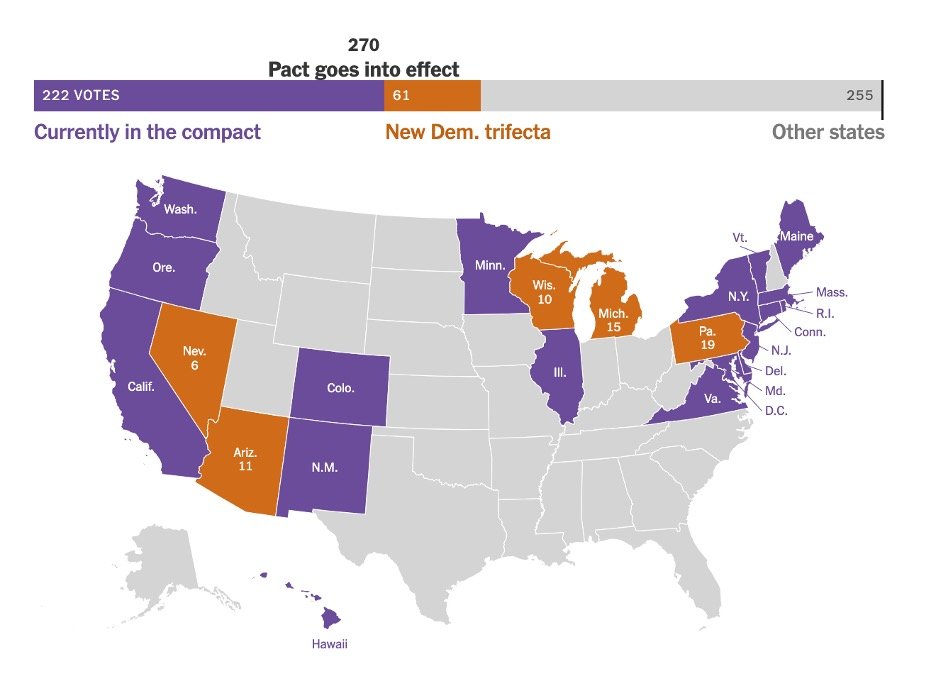
Democrats may have won enough state legislatures to trigger the National Popular Vote Interstate Compact: [36][37]
The National Popular Vote Interstate Compact (NPVIC) is an agreement among a group of U.S. states and the District of Columbia to award all their electoral votes to whichever presidential ticket wins the overall popular vote in the 50 states and the District of Columbia, regardless of which ticket won more votes in their individual state/district. Introduced in 2006, the compact is designed to ensure that the candidate who receives the most votes nationwide is elected president, and it would come into effect only when it would guarantee that outcome.
It has been joined by eighteen states and the District of Columbia as of September 2026. They have 222 electoral votes, which is 41% of the Electoral College and 82% of the 270 votes needed to give the compact legal force. The idea gained traction amongst scholars after George W. Bush won the presidential election but lost the popular vote in 2000, the first time the winner of the presidency had lost the popular vote since 1888. The compact gained even more momentum when Donald Trump won the presidential election in 2016, despite having received nearly three million fewer votes than his rival, Hillary Clinton.
Here’s how it might work from New York Times reporting: [38]
The states already in the pact represent 222 electoral votes. On Tuesday, Democrats in Arizona, Nevada, Michigan, Pennsylvania and Wisconsin achieved a “trifecta,” winning control of both chambers in their state legislatures and governor’s offices. If these states all joined the pact, they would represent a total of 283 electoral votes. That would be enough for the agreement, called the National Popular Vote Interstate Compact, to go into effect:
And with all of this, I’m sure there are more levels of impact awaiting us over the next couple of years. And I’m looking forward to it.
In the last of these posts, I’m going to discuss what I see as the end game of all of this. I think we’re going through a major political transformation, and I think the shift will take several more election cycles.
Notes and Sources
[1] Mic Farris, “Elections: The Ultimate Check and Balance,” Decisions, November 1, 2026, https://www.micfarris.com/articles/elections-the-ultimate-check-and-balance
[2] Mic Farris, “Preemptive Election Interference,” Decisions, October 27, 2026, https://www.micfarris.com/articles/preemptive-election-interference
[3] Mic Farris, “Election Interference,” Decisions, July 18, 2026, https://www.micfarris.com/articles/election-interference
[4] Mic Farris, “Decisions: Election 2025 Edition,” Decisions, November 1, 2025, https://www.micfarris.com/articles/election-2025-edition
[5] Mic Farris, Local Democracy in America, Amazon Kindle Direct Publishing, 2025.
[6] Christopher M. Richardson, “Dobbs isn’t the first time the Supreme Court took away key rights,” Los Angeles, Times, July 15, 2022, https://www.latimes.com/opinion/story/2022-07-15/supreme-court-abortion-civil-rights
[7] Oliver Stone, dir., Wall Street, film, Los Angeles: Twentieth Century Fox, 1987.
[8] “Gordon Gekko Because It's Wreckable,” HollywoodRanked, YouTube, poste April 17, 2025, https://www.youtube.com/watch?v=Ah84swz_xws
[9] Ibid.
[10] “The Facebook Dilemma,” Frontline, PBS, October 29, 2018, https://www.pbs.org/wgbh/frontline/documentary/facebook-dilemma/
[11] “MS NOW Voter Poll,” MS NOW, retrieved November 9, 2026, https://www.ms.now/elections/2026-general/us/exit-polls-midterms-ufcj
[12] Ibid.
[13] Ron DeSantis [@RonDeSantis], X, November 3, 2026, https://x.com/RonDeSantis/status/2117870135956435110
[14] “Ron DeSantis calls the election results an 'extinction level event for Republicans',” Associated Press, YouTube, November 4, 2026, https://www.youtube.com/watch?v=xPSFSzKPCAE
[15] Eric Benson, ““MAGA Needs To Be Dead”: Dade Phelan on the Republican Wipeout,” Texas Monthly, November 4, 2026, https://www.texasmonthly.com/news-politics/dade-phelan-extinction-level-election/
[16] Kabir Khanna, “Here’s how MS NOW will project control of the U.S. House,” MS NOW, retrieved November 9, 2026, https://www.ms.now/news/ms-now-u-s-house-majority-estimate
[17] Valerie Heitshusen, “Committee Types and Roles,” Congressional Research Service, 98-241, updated November 25, 2025, https://www.congress.gov/crs-product/98-241
[18] “GOP congressman introduces articles of impeachment against Hegseth,” CNN, November 9, 2026, https://www.cnn.com/2026/11/09/politics/live-news/midterm-election-trump-congress
[19] “Impeaching Peter Brian Hegseth, Secretary of Defense, for high
crimes and misdemeanors,” H. Res. ___ introduced by Rep. Thomas Massie, November 9, 2026, https://massie.house.gov/uploadedfiles/hegseth_articles_of_impeachment.pdf
[20] Jordan Rubin, “Democratic sweep locks in Thomas and Alito for an uncertain Supreme Court ride,” MS NOW, November 4, 2026, https://www.ms.now/deadline-white-house/deadline-legal-blog/midterms-thomas-alito-supreme-court-retirement
[21] “Disgorgement,” Legal Information Institute, Cornell Law School, retrieved November 9, 2026, https://www.law.cornell.edu/wex/disgorgement
[22] "The era of brazen corruption stops now," Podcast Rex, from Deadline: White House, MS NOW, November 4, 2026, https://podcastrex.com/shows/deadline-white-house/the-era-of-brazen-corruption-stops-now
[23] Stephan Bisaha, “Largest housing affordability bill in decades becomes law without Trump's signature,” NPR, July 11, 2026, https://www.npr.org/2026/07/10/nx-s1-5885027/housing-bill-without-trump-signature
[24] United States Constitution, Article V, https://www.archives.gov/federal-register/constitution/article-v.html
[25] Andrew Pantazi, “Democrats poised to break GOP's 16-year grip on statehouses,” Axios, November 5, 2026, https://www.axios.com/2026/11/05/2026-midterms-democrats-state-legislatures-trifectas
[26] Candace McCowan, “Georgia Election 2026: Black women now hold nearly all state executive offices,” WSB-TV, November 4, 2026, https://www.wsbtv.com/news/georgia/georgia-election-2026-black-women-now-hold-nearly-all-state-executive-offices/XBAGBHEUP5F2FHVY4ARVIPCJ24/
[27] Mike Leonard and Jordan Fischer, “Montana Dark Money Ban Sets Up Challenge to Citizens United (1),” Bloomberg Law, November 4, 2026, https://news.bloomberglaw.com/esg/montana-bans-dark-money-setting-up-challenge-to-citizens-united
[28] Jill Colvin, Mary Clare Jalonick, and Will Weissert, “Democrats win the US House and Senate as voters deliver a strong rebuke to Trump and Republicans,” AP News, November 3, 2026, https://apnews.com/article/midterm-election-house-senate-democrats-republicans-trump-f126e12e05b579a327b98481c0ae2226
[29] Robert Downen, “The Christian Nationalist Agenda Is Dead,” Texas Monthly, November 5, 2026, https://www.texasmonthly.com/news-politics/christian-nationalist-agenda-is-dead/
[30] Thomas Zimmer, “A Remarkable Moment in U.S. History,”, Democracy Americana, November 8, 2026, https://democracyamericana.com/posts/41a02b45-2231-4d8d-b9e5-667b0092663d
[31] Andrew Pantazi, “Democrats poised to break GOP's 16-year grip on statehouses,” Axios.
[32] Dave Roos, “Why Was the Electoral College Created?” History.com, July 15, 2019, https://www.history.com/articles/electoral-college-founding-fathers-constitutional-convention
[33] "United States presidential election of 1800," Britannica, retrieved November 9, 2026, https://www.britannica.com/event/United-States-presidential-election-of-1800
[34] John Ferling, Adams vs. Jefferson: The Tumultuous Election of 1800, New York, NY: Oxford University Press, 2004.
[35] “2016 United States presidential election,” Wikipedia, retrieved November 9, 2026, https://en.wikipedia.org/wiki/2016_United_States_presidential_election
[36] National Popular Vote, retrieved November 9, 2026, https://www.nationalpopularvote.com/
[37] “National Popular Vote Interstate Compact,” Wikipedia, retrieved November 9, 2026, https://en.wikipedia.org/wiki/National_Popular_Vote_Interstate_Compact
[38] Ben Blatt, “Democrats Now Have a Path to Sidestep the Electoral College. Would It Work?” New York Times, November 8, 2026, https://www.nytimes.com/2026/11/08/upshot/democrats-electoral-college.html
Decisions with Mic Farris
Seek Truth. Honor Differences.