Words as Weapons
Harvard scholars are calling April 7, 2026 a date that will live in infamy. Whether or not that’s true, there must still be accountability.
If you’d like these posts delivered directly to you, subscribe to the Decisions newsletter now!
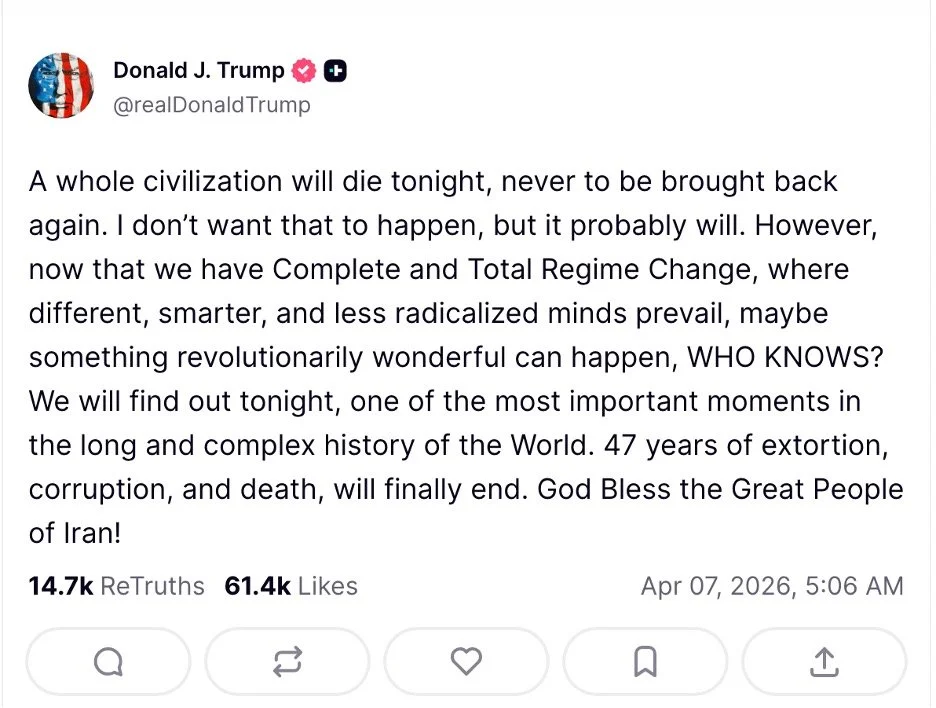
On April 7th, the President of the United States posted on social media that “a whole civilization will die tonight, never to be brought back again.” [1] He was talking about Iran and its 90 million people.
Mathias Risse, a political theorist at Harvard’s Carr-Ryan Center for Human Rights, just published a piece calling this the most explicit declaration of genocidal intent in the history of modern international law. He’s probably right. [2]
But I want to focus on something closer to home: why our own system - the one built specifically to stop this kind of thing - isn’t stopping it.
The Constitution Has an Answer; Congress Doesn’t
I’ve written before about Trump launching this war without Congressional authorization [3] - a clear violation of Article I, Section 8 of the Constitution, which places the power to declare war in the hands of Congress, not the President; that was in February. Now, months later, the war has escalated to a sitting President openly threatening an entire civilian population, and Congress has done next to nothing.
The Founders designed the separation of powers precisely for moments like this. The legislature checks the executive. The system works, but only when the legislature chooses to use it. Right now, it isn’t.
The Republican Party Is the Story
Much has been discussed about using the 25th Amendment, which allows the Vice President and the Cabinet to remove the President if he is “unable to discharge the powers and duties of his office,” but there are constitutional issues with how this all would work. U.S. Representative and constitutional scholar Jamie Raskin said recently he would be walking the Democratic Caucus through the constitutional paths. [4]
However, the 25th Amendment for removing a President just focuses responsibility on others to take care of this very acute problem.
Republicans control Congress. They have the constitutional tools: War Powers resolutions, hearings, the power of the purse, articles of impeachment. And they have chosen, consistently and deliberately, not to use them.
This is no longer passive failure; it’s active enablement. When the President says he’s “not at all” concerned about war crimes, [5] and Republican members of Congress respond with silence - or worse, cheerleading - they should be accountable for what comes next. Every strike, every threat, every escalation happens with their implicit blessing.
Which raises the real question: where is the line? What would it actually take for Republican members of Congress to say enough? We’ve seen an unconstitutional war. We’ve seen attacks on military lawyers and the gutting of the institutional checks within the Pentagon itself. We’ve now seen a President publicly threaten to wipe out a civilization. If that’s not the line, what is?
Complicity Has a Cost
The Supreme Court’s 2024 ruling in Trump v. United States - which I called one of the worst decisions in the Court’s history [6] - forecloses most domestic prosecution for official acts. International mechanisms can’t reach a permanent Security Council member. That leaves Congress as the last institutional check. And right now, that check is proving ineffective.
Risse closes his piece with a line that stuck with me: “Silence in the face of an explicit threat of civilizational destruction is complicity.” [7] He’s writing about the international community, but that indictment lands just as squarely on the Republicans sitting in the Capitol, who took an oath to defend the Constitution and are watching it be dismantled from the inside.
They will be held accountable. Maybe not today. But in November, in the new Congress, and in the history books that follow.
Narratives
The book I’m reading or movie I’m watching
Inside OpenAI (investigative report from The New Yorker)
Ronan Farrow of The New Yorker won the 2018 Pulitzer Prize for Public Service, sharing it with Jodi Kantor and Megan Twohey of The New York Times, “[f]or explosive, impactful journalism that exposed powerful and wealthy sexual predators, including allegations against one of Hollywood’s most influential producers [e.g., Harvey Weinstein], bringing them to account for long-suppressed allegations of coercion, brutality and victim silencing, thus spurring a worldwide reckoning about sexual abuse of women.” [8]
New interviews and closely guarded documents shed light on the persistent doubts about the head of OpenAI, Sam Altman. Altman promised to be a safe steward for A.I. But some of his colleagues believed that he was not trustworthy enough to, as one put it, “have his finger on the button.” [9]. You can read the article here.

GIF Game
Notes and Sources
[1] Donald J. Trump [@realDonaldTrump], Truth Social, April 7, 2026, https://truthsocial.com/@realDonaldTrump/posts/116363336033995961
[2] Mathias Risse, “"A Whole Civilization Will Die Tonight:" The Day the American President Threatened Genocide,” Harvard Kennedy School, Carr-Ryan Center for Human Rights, April 8, 2026, https://www.hks.harvard.edu/centers/carr-ryan/our-work/carr-ryan-commentary/whole-civilization-will-die-tonight-day-american
[3] Mic Farris, “War! Act II,” February 28, 2026, https://www.micfarris.com/articles/war-act-ii
[4] Nik Popli, “What Jamie Raskin Will Tell House Democrats About the 25th Amendment and Impeachment,” Time, April 10, 2026, https://time.com/article/2026/04/10/rep-jamie-raskin-explains-prospects-of-impeaching-trump-25th-amendment/
[5] George Chidi, “Retired military officers call Trump’s threats against Iran ‘likely war crimes’,” The Guardian, April 7, 2026, https://www.theguardian.com/us-news/2026/apr/07/trump-iran-threats-retired-military-war-crimes
[6] Mic Farris, “Trump v. United States,” February 8, 2026, https://www.micfarris.com/articles/trump-v-united-states
[7] Mathias Risse, “‘A Whole Civilization Will Die Tonight’,” April 6, 2026
[8] “The New York Times, for reporting led by Jodi Kantor and Megan Twohey, and The New Yorker, for reporting by Ronan Farrow,” The Pulitzer Prizes, The 2018 Pulitzer Prize Winner in Public Service, retrieved April 12, 2026, https://www.pulitzer.org/winners/new-york-times-reporting-led-jodi-kantor-and-megan-twohey-and-new-yorker-reporting-ronan
[9] Ronan Farrow and Andrew Marantz, “Sam Altman May Control Our Future—Can He Be Trusted?” The New Yorker, April 6, 2026, https://www.newyorker.com/magazine/2026/04/13/sam-altman-may-control-our-future-can-he-be-trusted
Decisions with Mic Farris
Seek Truth. Honor Differences.