It Only Took an Hour
The proposal was so bad, voters rejected it four-to-one
If you’d like these posts delivered directly to you, subscribe to the Decisions newsletter now!
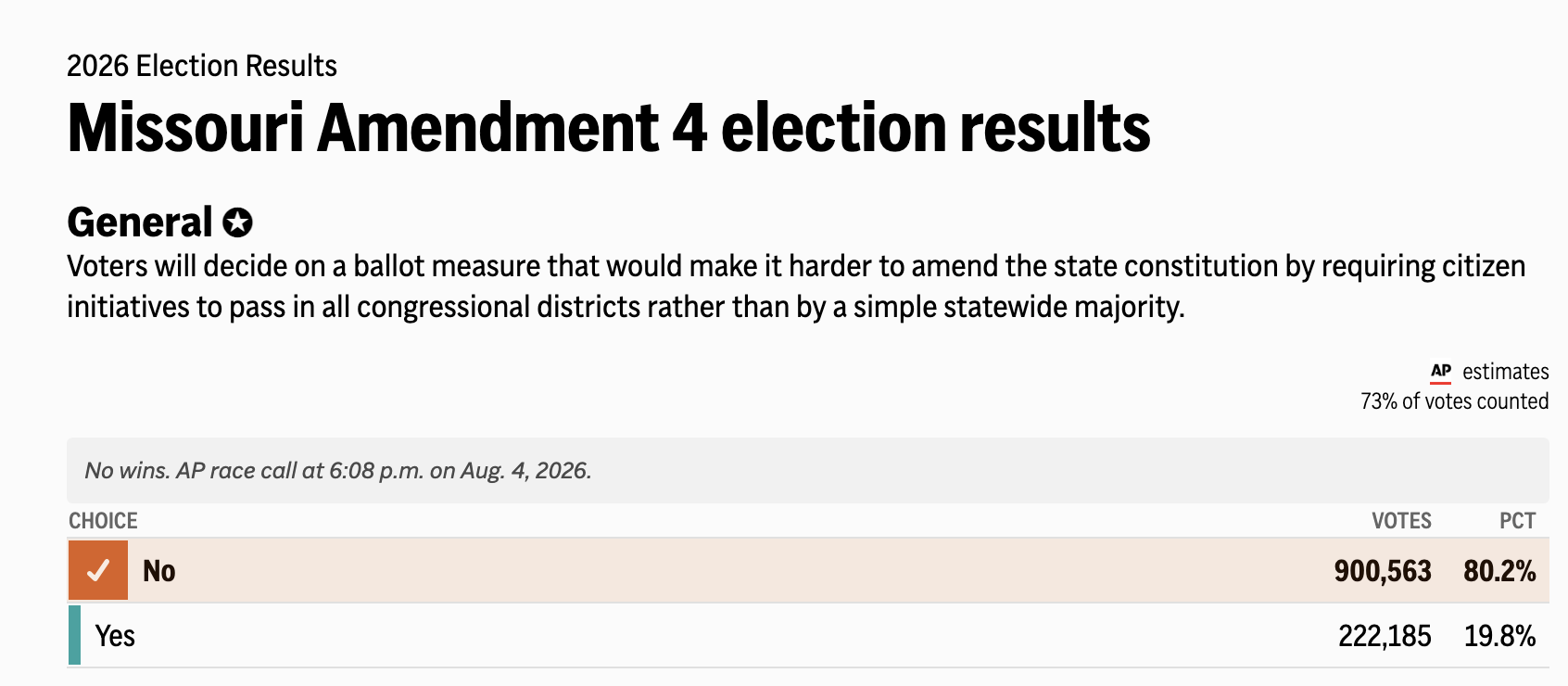
The Associated Press called it just over an hour after the polls closed. Missouri's Amendment 4 - which would have required future citizen initiatives to win a majority in every one of the state's eight Congressional districts, not just a statewide majority - was defeated.
One hour. The defeat was so resounding that the AP called the result that soon after the polls closed.
According to Missouri Independent reporting, “Amendments 4 and 5 rank among the least popular constitutional amendments in Missouri history.” [1]
Amendment 5, which sought to phase out Missouri’s income tax and allow lawmakers to replace the lost revenue with broader sales taxes, drew just 16.6% of the vote Tuesday — the third-lowest level of support for any constitutional amendment since Missouri adopted the initiative process in 1908.
Amendment 4, another Republican legislative priority, fared only slightly better. The proposal to require citizen-led constitutional amendments to win statewide and in all eight congressional districts received 19.7%.
Amendment 4 would have replaced approval of constitutional amendments with something closer to the Articles of Confederation or the electoral college inside a single state; however, this would only apply for citizens initiatives.
For a voter-initiated constitutional amendment, you’d have to win all eight district elections; win seven of eight districts by a landslide, lose the eighth by a hair, and the whole thing fails - even if you won 65% of the vote statewide.
Yet, for an amendment placed on the ballot by the legislature, no such district requirement - simple statewide approval counts for the measures proposed by politicians.
One set of rules for politicians putting something in front of voters. A harder one for voters putting something in front of themselves.
This was purposeful engineering by those in power, and efforts to mess with election rules aren’t isolated to Missouri.
In North Carolina right now, there's a bill that would let residents challenge ballots cast by other voters three days after an election - after results are already starting to go public. Here’s more background from NBC News reporting: [2]
The Republican-led North Carolina House approved a bill Tuesday that would make it easier for residents to challenge other people’s votes and county boards to toss those ballots, alarming critics who say the law could cause post-election chaos.
The bill, which the Senate passed last week, would allow county residents to challenge early voters’ ballots up to three business days after an election. County election boards could then vote to invalidate those votes with a simple majority of members.
Currently, early vote challenges must be filed the day they were cast — before anyone knew how close a race was and how many votes would need to be thrown out to change the outcome — and precinct officials decide the matter on the same day, while only absentee ballot challenges go to the county board. Around 5% of voters cast a ballot by mail in 2024.
County election boards are controlled by Republicans after state legislators stripped the governor of his appointment power and gave it to state Auditor Dave Boliek, a Republican.
In California, a common move when politicians can't kill a citizen initiative outright is to place a competing, watered-down measure on the same ballot - split the vote, confuse the choice, let the weaker version win on a technicality.
Unfortunately, this is a long-standing practice – one of many tactics I’ve written about before. [3][4] For example, in Thousand Oaks, the City Council tried doing this several times to put weaker measures on the ballot – attempting to blunt citizen-initiated growth control and open space protection measures. [5][6][7]
I’ve also written about this in my book Local Democracy in America, noting that letting the people decide is not a natural impulse. [8] Our democratic system has to be built, protected, and re-defended every time someone in power gets the chance to rewrite the rules that got them there. Missouri voters defended it this week, but not everywhere will.
As I wrote in Local Democracy in America: "When those in power use their power to stay in power, democracy withers." [9]
Notes and Sources
[1] Rudi Keller, “Historic defeats for Missouri GOP priorities raise questions about what comes next,” Missouri Independent, August 7, 2026, https://missouriindependent.com/2026/08/07/historic-defeats-for-missouri-gop-priorities-raise-questions-about-what-comes-next/
[2] Jane C. Timm, “North Carolina lawmakers vote to make post-election challenges easier,” NBC News, August 4, 2026, https://www.nbcnews.com/politics/elections/north-carolina-lawmakers-vote-make-post-election-challenges-easier-rcna590885
[3] Mic Farris, “Cracks in American Democracy: Louisiana Edition,” Decisions, May 2, 2026, https://www.micfarris.com/articles/cracks-in-american-democracy-louisiana-edition
[4] Mic Farris, “Gerrymander Disaster,” Decisions, December 7, 2025, https://www.micfarris.com/articles/gerrymander-disaster
[5] James Quinn, “Two Growth Plans May Go on Ballot,” Los Angeles Times, December 9, 1979.
[6] Minutes of Thousand Oaks City Council, February 5, 1980.
[7] Miguel Bustillo, “Planner’s Open Space Initiative Divides Officials,” Los Angeles Times, March 25, 1996.
[8] Mic Farris, Local Democracy in America, Kindle Publishing, 2025, p 3, https://www.amazon.com/Local-Democracy-America-Elections-Self-Governance/dp/B0FQ65XSVB/
[9] Mic Farris, Local Democracy in America, p 10.
Decisions with Mic Farris
Seek Truth. Honor Differences.